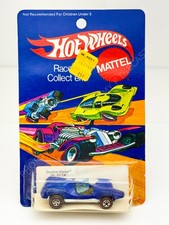
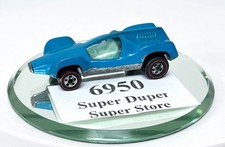
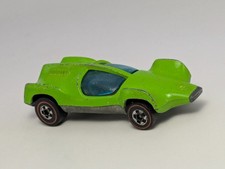
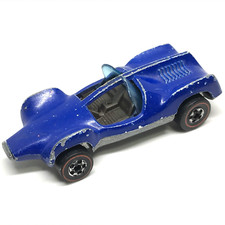
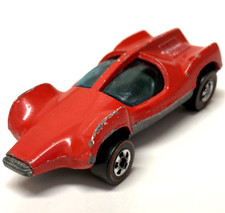
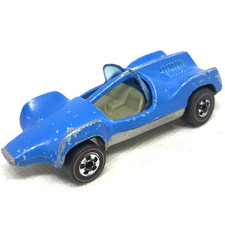
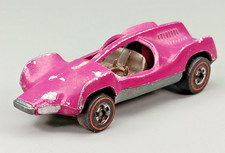
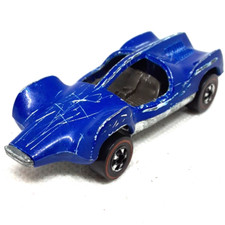
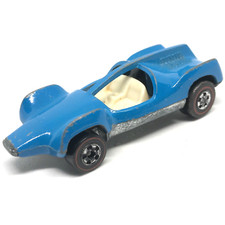
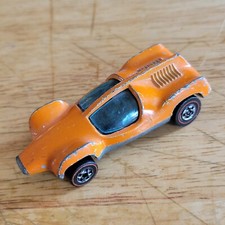
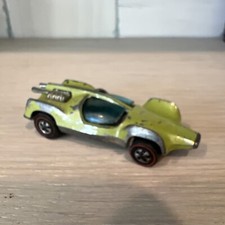
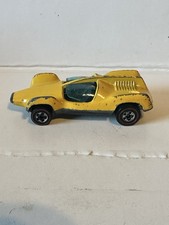
1973 Hot Wheels Redline Double Vision Collector Guide
Quick Value Snapshot
| Item |
Collector Notes |
| Model |
1973 Hot Wheels Redline Double Vision |
| Production |
1973 only |
| Country of production |
Hong Kong |
| Previous casting |
Based on the 1970 Mantis casting |
| Key casting change |
Most Double Vision examples were produced without the exposed engine found on the earlier Mantis |
| Important exception |
The Lime version is noted for retaining the engine |
| Value confidence |
Limited without verified recent sold-price data; use completed sales, not active asking prices, when estimating value |
Collector Summary
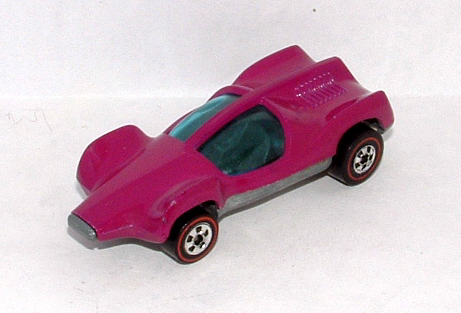
The 1973 Hot Wheels Redline Double Vision is a Hong Kong-produced late-era Redline casting derived from the earlier 1970 Mantis. It was produced for one model year only, which makes it a focused casting for collectors who build year sets, Hong Kong Redline groups, or casting-evolution displays.
The main identifying feature is its relationship to the Mantis casting. While the earlier Mantis included an exposed engine, the Double Vision generally does not. The major exception is the Lime version, which is known for retaining the engine. The canopy still swivels upward, continuing one of the distinctive play features from the earlier casting.
For collectors, the Double Vision is important because it sits at the transition point between the earlier Spectraflame-heavy Redline period and the later design direction of Hot Wheels. Condition, originality, correct parts, and the presence or absence of the engine on the correct color are all important when evaluating one.
Known Variations and Details
| Feature |
Known Detail |
| Casting origin |
Derived from the 1970 Mantis casting |
| Production year |
1973 only |
| Manufacturing location |
Hong Kong |
| Engine detail |
Most versions are missing the exposed engine used on the Mantis |
| Lime version |
Known exception that retained the engine |
| Canopy |
Swivels upward, similar to the Mantis |
| Wheels |
Redline wheels are expected; verify originality and correct axle fitment |
Color and Desirability Notes
The Lime Double Vision deserves special attention because it is noted as the version that retained the engine. That makes it different from the more typical Double Vision configuration, where the engine is absent. When evaluating a Lime example, confirm that the engine is original to the car and not a later-added part.
For other colors, the lack of the engine should not automatically be treated as damage or incompleteness, because the missing engine is a known production change from the earlier Mantis. Buyers should be careful not to confuse a normal Double Vision with a damaged Mantis or a modified casting.
As with most Redline models, brighter paint, cleaner glass, intact moving features, undamaged bases, and original wheels all improve desirability. Color alone should not be used to assign value without also considering condition and originality.
Condition Factors That Affect Value
- Original paint: Factory paint is preferred. Repaints and restorations should be valued separately from original examples.
- Canopy operation: The swiveling canopy should move correctly and should not be cracked, glued, heavily scratched, or replaced without disclosure.
- Engine configuration: Most Double Vision examples are expected to lack the engine. The Lime version is the important exception and should be checked carefully.
- Wheel condition: Original Redline wheels with good chrome, clean redlines, and straight axles are more desirable.
- Base condition: Look for corrosion, axle damage, drilled rivets, tampering, or signs of a parts swap.
- Play wear: Edge chips, roof wear, nose wear, and base scratches are common on played examples and reduce value.
- Completeness: Missing, broken, or incorrect moving parts reduce collector interest unless clearly disclosed as a project car.
Restorer Notes
The Double Vision can be a useful restoration candidate when paint is poor, wheels are damaged, or the canopy is broken. However, restored cars should be represented as restored and should not be priced or described as original mint examples.
Restorers should pay close attention to the engine issue. Adding an engine to a non-Lime Double Vision may create an inaccurate restored car if the goal is factory-correct presentation. For a Lime version, the engine is a key feature and should be handled carefully. If replacement parts are used, they should be disclosed.
Because the canopy is a visible moving feature, scratches, cracks, clouding, and incorrect replacement parts can noticeably affect presentation. Avoid over-polishing or modifying original parts if the car is otherwise collectible.
Buyer Cautions
- Do not assume asking price equals value. Active listings often reflect seller hopes, not confirmed market results.
- Separate original from restored. A restored Double Vision may display well but should not be compared directly with an original example.
- Check for drilled rivets. Opened cars may have swapped wheels, canopies, interiors, or engines.
- Verify the Lime engine exception. A Lime car with an engine is notable, but originality still matters.
- Watch for Mantis confusion. Since the Double Vision came from the Mantis casting, incorrect listings may mix the two names or parts.
- Avoid wrong-casting comparisons. Do not use Mantis prices, custom builds, or altered cars as normal Double Vision value references.
- Be cautious with lots. Multi-car lots can hide condition problems and usually do not provide clean single-car price data.
Seller Notes
When selling a 1973 Double Vision, clearly photograph the top, sides, base, wheels, canopy, and rivets. Include close-up photos of the canopy hinge area and any engine detail if present. If the car is Lime and has the engine, state that clearly, but avoid claiming a premium unless supported by comparable sold examples.
Describe the car as original, restored, repainted, repaired, or customized as accurately as possible. If you do not know whether parts are original, say so. Accurate disclosure helps prevent returns and improves buyer trust.
Do not use active asking prices alone to justify a value. The most useful comparisons are verified sold listings for the same casting, similar condition, same originality status, and comparable color.
Pricing Analysis
No specific verified sold-price examples are supplied here, so value confidence is limited. The best pricing method is to separate three categories: active asking prices, actual sold prices, and non-comparable listings.
| Price Type |
How to Use It |
| Active asking prices |
Useful for seeing current seller expectations, but they should not be treated as market value |
| Actual sold prices |
Most useful for estimating current value when the car is original, correctly identified, and in comparable condition |
| Lots and mixed groups |
Use carefully because the single-car value is usually unclear |
| Restored or repainted cars |
Track separately from original examples |
| Damaged or parts cars |
Useful only for project-value context, not normal collector value |
| Strong outliers |
Review separately; unusual prices may reflect rare condition, bidding behavior, incorrect identification, or non-comparable details |
For original examples, the most important pricing factors are condition, color, originality, canopy condition, wheel quality, and whether the engine configuration matches known factory expectations. The Lime version with its engine should be evaluated with extra care because that feature is specifically noted as an exception.
Listings to Exclude or Treat Carefully
- Active listings with high asking prices and no sale confirmation
- Repainted, restored, customized, or heavily polished examples
- Cars with reproduction parts unless clearly disclosed and priced accordingly
- Examples with drilled rivets or suspected parts swaps
- Damaged cars with broken canopies, missing wheels, bent axles, or major corrosion
- Mixed lots where the Double Vision cannot be valued separately
- Listings that confuse the Double Vision with the earlier Mantis
- Cars with added engines where the color and originality do not support that configuration
New Collector Advice
If you are new to Redlines, start by learning the difference between the 1970 Mantis and the 1973 Double Vision. The Double Vision is based on the Mantis, but most Double Vision examples do not have the exposed engine. Do not automatically assume a missing engine means the car is incomplete.
Buy the best original condition you can comfortably afford, and prioritize complete, honest examples over cars with unclear histories. Look closely at the canopy, wheels, base, and rivets before buying. When comparing prices, use actual sold examples whenever possible rather than active listings.
Advanced Collector Notes
Advanced collectors may focus on documenting color, engine configuration, and casting continuity from Mantis to Double Vision. The Lime version is especially important because it retained the engine while other versions generally did not. This makes it a key reference point for studying the casting transition.
Because the model was produced in Hong Kong for 1973 only, careful inspection of base details, wheel originality, and factory assembly characteristics is important. Examples with untouched rivets, original wheels, clean canopy action, and strong paint are the most useful as reference pieces.
Short Page Blurb
The 1973 Hot Wheels Redline Double Vision was a Hong Kong-produced, one-year-only casting based on the earlier Mantis. Most versions were made without the Mantis-style exposed engine, while the Lime version is the noted exception that retained it. Collectors should verify originality, canopy condition, wheel condition, and correct engine configuration before assigning value.
Disclaimer
Values for Redline Hot Wheels vary by condition, originality, color, timing, and buyer demand. Active asking prices are not the same as sold prices, and no exact value is guaranteed. Restored cars, repaints, customs, reproduction parts, damaged examples, mixed lots, and wrong-casting listings should be evaluated separately from original collector-grade examples.
 Total results 0