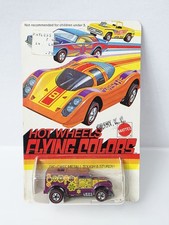
1972 Hot Wheels Redline Funny Money Collector Guide
Quick Value Snapshot
| Example Type |
Collector Value Impact |
Pricing Confidence |
| Complete, original Hong Kong example with orange bumper and factory blue “Funny Money” decal |
Best normal collector demand for this casting |
Moderate to limited without current verified sold-price data |
| Original car missing the orange bumper |
Reduced value; incomplete for collector purposes |
Moderate |
| Original car with worn or missing decal |
Reduced value, especially for display-grade collectors |
Moderate |
| Restored, repainted, custom, or reproduction-parts example |
Should be priced separately from original examples |
Depends heavily on disclosure and workmanship |
| Active asking-price listings |
Useful for monitoring seller expectations only |
Not the same as market value |
| Actual sold-price results for correct, original, comparable examples |
Best pricing evidence when condition and completeness are verified |
Highest confidence when recent and well documented |
Collector Summary
The 1972 Hot Wheels Redline Funny Money was designed by Larry Wood and was produced for 1972 only. It is associated with the Heavyweights Series, even though that series had already been discontinued. The model was produced only in Hong Kong.
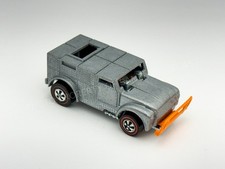
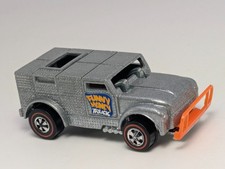
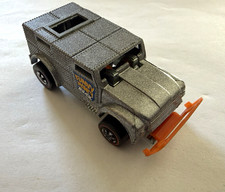
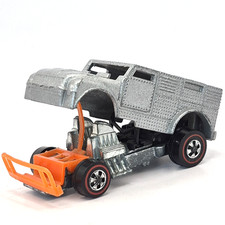
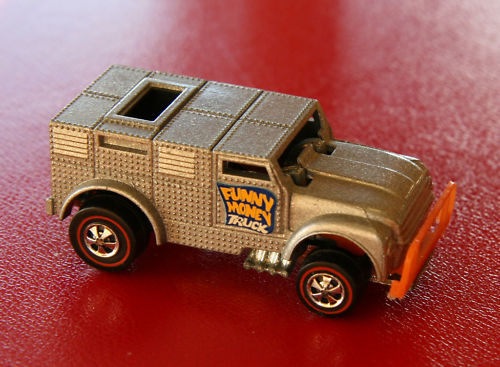
The Funny Money is a dragster-style Redline casting with a lift-up body that reveals twin engines. A correct example should have the factory-applied blue “Funny Money” decal and the orange bumper. The orange bumper is an important completeness part and should be present when describing a car as complete.
For collectors, the main value drivers are originality, Hong Kong construction, decal condition, the presence of the orange bumper, clean lift-up body function, wheel condition, and overall paint preservation.
Known Variations and Details
| Feature |
Known Detail |
| Year |
1972 only |
| Designer |
Larry Wood |
| Production origin |
Hong Kong only |
| Series association |
Heavyweights Series, despite the series having been discontinued |
| Body style |
Dragster-style lift-up body |
| Engine detail |
Twin engines visible when the body is lifted |
| Factory decal |
Blue “Funny Money” decal applied at the factory |
| Completeness part |
Orange bumper should be present |
| Wheel setup |
2 medium Redline wheels and 2 large Redline wheels |
Color and Desirability Notes
The supplied listing data does not provide a full factory color range for the Funny Money, so color-based rarity should be handled carefully. New collectors should not pay a premium for a claimed rare color unless the example is clearly original and supported by reliable Redline references or expert review.
For this model, completeness and originality are especially important. A clean original car with the correct factory blue “Funny Money” decal and orange bumper will generally be more desirable than a brighter-looking example that has been restored, repainted, re-decaled, or fitted with reproduction parts.
As with most Redline-era Hot Wheels, strong paint, bright wheels, intact redlines, clean base condition, and unbroken functional parts all contribute to desirability.
Condition Factors That Affect Value
- Orange bumper present: This is a key completeness item. Missing bumpers reduce collector value.
- Factory decal condition: The blue “Funny Money” decal should be original if the car is being represented as original. Wear, lifting, staining, replacement, or absence affects value.
- Lift-up body function: The body should open and close properly without looseness, breakage, or forced alignment.
- Twin engine detail: Visible engine detail should be present and undamaged.
- Paint condition: Edge wear, roof wear, body chips, toning, scratches, and playwear all affect price.
- Wheel condition: Correct 2 medium and 2 large Redline wheel setup matters. Bent axles, worn redlines, replaced wheels, or mismatched wheels reduce originality.
- Base condition: Check for corrosion, heavy toning, scratches, tool marks, and signs of tampering.
- Originality: Original paint, original decal, original wheels, and original orange bumper are preferred by most advanced collectors.
Restorer Notes
The Funny Money can be restored for display, but a restored example should not be valued the same as an original survivor. Replacement decals, reproduction bumpers, repainting, wheel swaps, and rebuilt parts must be disclosed clearly when selling or trading.
If restoring, preserve any original factory decal when possible. The decal is a major identifying and display feature of the casting. Removing a worn but original decal may make the car look cleaner, but it can reduce historical originality.
Because the model uses a lift-up body, restorers should inspect the hinge and opening mechanism before disassembly or repainting. Fit and function matter. A restored car that does not open correctly, does not sit properly, or uses incorrect wheel sizes will be less appealing to informed collectors.
Buyer Cautions
- Do not treat asking prices as market value. Asking prices only show what a seller hopes to receive.
- Use actual sold prices for comparison. The best comps are sold examples that are original, complete, Hong Kong-made, and in similar condition.
- Confirm the orange bumper. A Funny Money without the orange bumper should be considered incomplete unless clearly described otherwise.
- Inspect the decal. Reproduction decals can improve appearance but should not be priced like untouched factory-applied decals.
- Watch for restored or customized cars. Bright paint, perfect decals, or unusually fresh parts can be legitimate, but they require disclosure.
- Avoid wrong comparisons. Do not compare damaged cars, lots, customs, restored cars, reproduction-parts cars, or incorrect castings against original complete examples.
- Check the wheel setup. The known wheel configuration is 2 medium and 2 large Redline wheels.
Seller Notes
When selling a 1972 Funny Money, describe the car by originality, completeness, and condition rather than relying only on broad terms such as “rare” or “nice.” Clear photos of the decal, orange bumper, wheel sizes, base, lift-up body, and engine area are important.
State whether the blue “Funny Money” decal is original or replaced. State whether the orange bumper is original, reproduction, missing, repaired, or unknown. If the car has been repainted, touched up, re-decaled, wheel-swapped, or repaired, disclose that information clearly.
For pricing, separate active asking prices from actual sold prices. If referencing market activity, use recent sold examples that match your car’s condition and originality as closely as possible.
Pricing Analysis
Pricing confidence is limited without current verified sold-price data for comparable examples. The most reliable pricing method is to review actual sold results for correct 1972 Hong Kong Funny Money cars and separate them by condition, originality, and completeness.
Complete original examples with the orange bumper and factory blue “Funny Money” decal should be evaluated separately from incomplete cars. Missing bumpers, replaced decals, repaints, damaged bodies, incorrect wheels, and customs can create large price differences.
Active listings can be useful for understanding how sellers are positioning the model, but they should not be treated as confirmed value. Strong outliers should be checked carefully for unusual condition, original packaging, verified exceptional preservation, restoration work, reproduction parts, or listing errors.
Listings to Exclude or Treat Carefully
- Cars sold in mixed lots where the individual Funny Money value cannot be separated
- Repainted or restored examples being compared to original cars
- Custom builds or fantasy-color examples
- Examples with reproduction decals or reproduction orange bumpers unless clearly disclosed
- Cars missing the orange bumper but described as complete
- Damaged examples with broken lift-up body mechanisms or missing engine detail
- Wrong-casting listings or misidentified Heavyweights-related listings
- Listings using only active asking prices as proof of value
- Listings with poor photos that do not show the decal, bumper, base, wheels, and opening body
New Collector Advice
If you are buying your first Funny Money, focus on a complete, honest example. The orange bumper and factory blue “Funny Money” decal are the two details to check first. Then inspect the wheels, base, lift-up body, and engine area.
Do not rush into paying a high price for a car described as rare unless the seller provides clear photos and the condition supports the price. A clean original car with some honest wear may be a better collector piece than a restored car that is not clearly disclosed.
When comparing prices, look for sold examples, not just current listings. Make sure the sold examples are also Hong Kong Funny Money cars and not restored, incomplete, or part of a mixed lot.
Advanced Collector Notes
Advanced collectors should pay close attention to originality markers: factory decal appearance, bumper originality, correct wheel sizes, undisturbed axle and base condition, and the fit of the lift-up body. The Funny Money’s combination of a factory decal, removable-looking detail parts, and opening body makes it a casting where undisclosed restoration can be easy to miss in poor photos.
Because production was Hong Kong only and limited to 1972, incorrect origin claims should be questioned. Comparisons should be made only against the same casting, same production origin, and similar completeness level.
For high-grade examples, documentation matters. Clear images of all sides, base, bumper, decal, wheels, and the open-body engine view are useful for confirming condition and avoiding disputes.
Short Page Blurb
The 1972 Hot Wheels Redline Funny Money is a Larry Wood-designed, Hong Kong-only release associated with the Heavyweights Series. It features a dragster-style lift-up body, twin engines, a factory blue “Funny Money” decal, and a required orange bumper for completeness. Originality, decal condition, bumper presence, wheel condition, and body function are the main collector value factors.
Disclaimer
Values for vintage Hot Wheels Redlines vary by condition, originality, completeness, timing, and buyer demand. Active asking prices are not the same as actual sold prices. Repaints, restorations, customs, reproduction parts, damaged cars, mixed lots, and misidentified listings should not be used as normal price comparisons for original examples. This guide does not guarantee exact values and should be used with current verified sold-price research.
 Total results 2