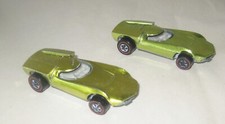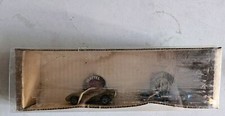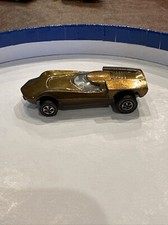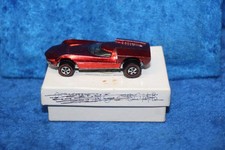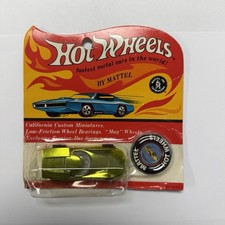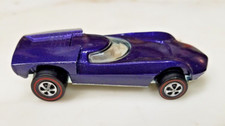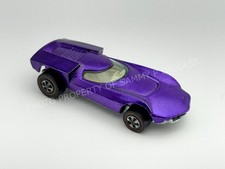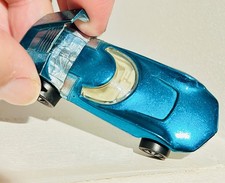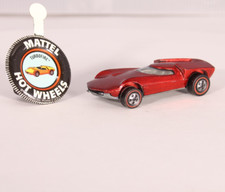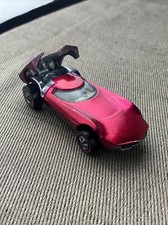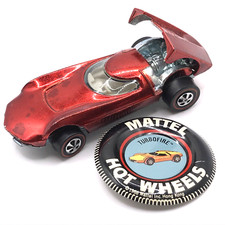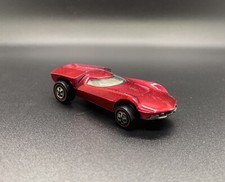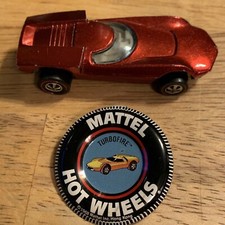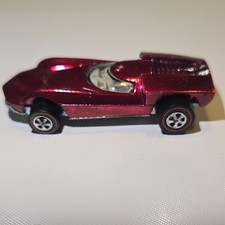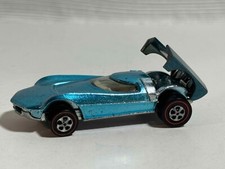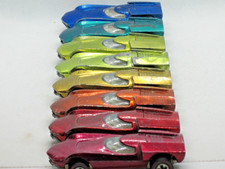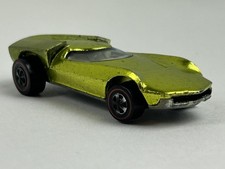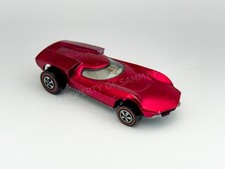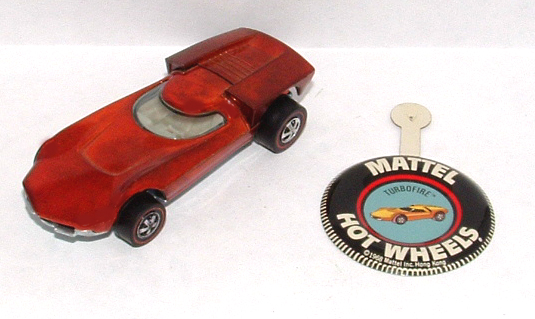
Casting #: 6259
Turbofire
Designer: Ira Gilford
Production Run: 1969-1971
Note: Produced only in the U.S. Most versions will have a white interior, but black/brown interiors command an additional premium, as they're more difficult to find.
Picture and description thanx to NCHWA.comOpenAI/ChatGPT Collector Guide
1969 Hot Wheels Redline Turbofire Collector Guide
Quick Value Snapshot
| Category |
Collector Value Notes |
| Typical loose original |
Value depends heavily on paint, wheel condition, glass, base, and whether the interior is the common white version or a scarcer dark interior. |
| High-grade loose original |
Clean Spectraflame paint, bright base, correct Redline wheels, intact glass, and minimal playwear place an example well above average loose cars. |
| Dark interior examples |
Black or brown interiors are harder to find than white interiors and generally command a premium when original. |
| Restored, repainted, or reproduction-part cars |
Should not be priced as original examples. They may have display value, but they are a separate market from original Redlines. |
| Current pricing confidence |
Limited without verified recent sold examples. Active asking prices should not be treated as confirmed market value. |
Collector Summary
The 1969 Hot Wheels Redline Turbofire is an original-era Redline casting designed by Ira Gilford. It was produced from 1969 through 1971 and, according to the supplied production notes, was produced only in the United States.
The Turbofire is a fantasy-style concept car from the early Hot Wheels period, with the low stance, exposed cockpit feel, and Spectraflame finish that collectors associate with Mattel’s first-generation Redlines. Most examples are found with a white interior. Examples with black or brown interiors are more difficult to locate and are considered premium variations when confirmed original.
For value purposes, the Turbofire should be evaluated like other early Redlines: originality, paint quality, wheel correctness, base condition, glass condition, and interior authenticity matter more than any single claimed price.
Known Variations and Details
| Feature |
Known Detail |
| Model |
Turbofire |
| Designer |
Ira Gilford |
| Production run |
1969-1971 |
| Production origin |
United States only, per supplied notes |
| Interior |
White is most common; black and brown interiors are scarcer and bring a premium when original |
| Wheel setup |
2 medium wheels and 2 small wheels |
| Era |
Original Redline era |
Color and Desirability Notes
The Turbofire was produced in Spectraflame-style finishes typical of the early Redline period. As with other Redlines, color desirability is affected by both the actual color and the quality of the finish. Strong, even paint with minimal toning, edge wear, or spotting is preferred.
For this casting, interior variation is especially important. A white interior is the normal version. A black or brown interior should be examined carefully, because dark interiors are scarcer and more valuable only when they are original to the car and not swapped or altered.
Collectors should avoid relying on color alone when assigning value. A more common color in excellent original condition may be more desirable than a scarcer color with heavy wear, replacement parts, or uncertain originality.
Condition Factors That Affect Value
- Original paint: Original Spectraflame paint is central to value. Repaints and touch-ups should be valued separately from untouched originals.
- Paint wear: Edge wear, roof or nose chips, high-point wear, scratches, toning, and corrosion lower desirability.
- Interior color: White is standard. Black or brown interiors are premium variations if original.
- Glass condition: Cracks, heavy scratches, fogging, or loose glass reduce value.
- Wheels: The correct setup is 2 medium wheels and 2 small wheels. Missing, replaced, cracked, or incorrect wheels affect value.
- Axles: Bent axles, poor rolling, or signs of wheel replacement should be noted.
- Base: A clean, undamaged base is preferred. Heavy oxidation, pry marks, drilled posts, or repaint evidence are significant issues.
- Playwear: Honest playwear is common, but heavy damage places an example below collector-grade cars.
- Completeness: Missing or incorrect parts should be disclosed and priced accordingly.
Restorer Notes
The Turbofire can be a good restoration candidate when the original paint is heavily worn or the car has damaged wheels, glass, or interior components. However, restored examples should always be represented as restored and should not be priced as original Redlines.
Restorers should pay close attention to the wheel setup of 2 medium and 2 small Redline wheels. Incorrect wheel sizes are easy to spot for experienced collectors and can reduce buyer confidence. Interior color also matters: a dark interior in a restored car should not be described as a rare original dark-interior variation unless the car’s originality can be verified.
If reproduction parts are used, they should be clearly disclosed. A clean restoration may be attractive for display, but it remains separate from the market for original paint, original-part examples.
Buyer Cautions
- Do not treat asking prices as value. A listed price is only a seller’s asking price until a comparable example actually sells.
- Confirm originality. Look for signs of repainting, polishing, post tampering, replacement glass, wheel swaps, or interior swaps.
- Be careful with dark interiors. Black and brown interiors are more desirable, but they should be authenticated as original before paying a premium.
- Check wheel sizes. The correct wheel arrangement is 2 medium and 2 small wheels. Incorrect wheels may indicate replacement or a mixed-part car.
- Avoid comparing to lots. Multi-car lots, parts lots, and mixed-condition groups do not provide clean value data for a single Turbofire.
- Separate restored from original. Restored, custom, or repainted examples are not normal price references for original Redlines.
- Watch for wrong-casting listings. Make sure the car being sold is actually a Turbofire and not another early fantasy casting.
Seller Notes
When selling a 1969 Hot Wheels Redline Turbofire, clear identification and honest condition notes are more useful than broad claims. Include sharp photos of the top, sides, front, rear, base, interior, glass, and all four wheels.
- State whether the paint is believed to be original or restored.
- Identify the interior color clearly: white, black, or brown.
- Photograph the base and wheel setup.
- Disclose cracked glass, bent axles, replaced wheels, drilled posts, touch-ups, or reproduction parts.
- If the car has a dark interior, provide enough photos to help buyers judge whether it appears original.
- Use sold examples for pricing research, not only active asking prices.
Pricing Analysis
No verified recent sold-price dataset was supplied for this page, so pricing confidence is limited. A responsible valuation should separate active asking prices from actual sold prices.
| Pricing Source |
How to Use It |
Reliability |
| Active asking prices |
Useful for seeing what sellers hope to receive, but not proof of market value. |
Limited |
| Actual sold prices |
Best reference when the car is clearly original, correctly identified, and comparable in condition. |
Higher |
| Lots or mixed groups |
Should not be used as direct single-car value references unless the Turbofire’s individual contribution is clear. |
Low |
| Restored or custom cars |
Relevant only to the restoration/display market, not to original Redline valuation. |
Separate market |
| Damaged or parts cars |
Useful only for lower-end or restoration-candidate pricing. |
Limited |
In general, the strongest Turbofire values are associated with clean original paint, correct wheels, intact glass, a clean base, and verified scarce interior variations. Average played-with white-interior examples should not be valued the same as high-grade original examples or confirmed dark-interior cars.
Listings to Exclude or Treat Carefully
- Repainted Turbofires being compared to original paint examples
- Custom or fantasy-modified cars
- Restored cars with reproduction wheels, glass, or interiors
- Cars with drilled posts or signs of disassembly
- Listings where the interior color is unclear but a dark-interior premium is claimed
- Cars with incorrect wheel sizes or obvious wheel swaps
- Multi-car lots where the Turbofire cannot be valued separately
- Listings with poor photos, missing base images, or no clear view of the wheels
- Wrong-casting listings or vague “Redline car” descriptions
- Heavily damaged examples used as if they represent normal collector-grade value
New Collector Advice
If you are new to Redlines, start by learning the difference between an original car, a restored car, and a parts car. The Turbofire is a good casting to study because it has a common interior version and scarcer dark-interior versions.
- Look for original paint first.
- Confirm the car has 2 medium and 2 small Redline wheels.
- Do not pay a dark-interior premium unless the interior appears original.
- Compare only to similar condition cars.
- Use sold results when available, not just asking prices.
- Buy the best condition example you can understand and verify.
Advanced Collector Notes
Advanced collectors should focus on originality, interior verification, paint shade, and untouched construction. Because black and brown interiors are harder to find than white interiors, they require closer inspection. Look for consistency between the interior, posts, base, and overall wear pattern. A clean dark interior in a heavily worn or tampered car deserves extra scrutiny.
For high-end examples, condition details become more important: wheel chrome, tire lettering and wear, axle straightness, glass clarity, base brightness, and the absence of post disturbance can all affect final value. Strong outliers should be treated separately, especially if they involve blister-pack examples, unusually high-grade condition, scarce interior variations, or unusually aggressive asking prices that have not been confirmed by a sale.
Short Page Blurb
The 1969 Hot Wheels Redline Turbofire is a U.S.-produced Ira Gilford design made from 1969 to 1971. Most examples have white interiors, while black and brown interiors are scarcer and bring a premium when original. Correct cars use 2 medium and 2 small Redline wheels, and value depends heavily on originality, paint condition, wheel correctness, glass, base condition, and verified interior variation.
Disclaimer
This guide is for collector reference only. Values can change based on condition, originality, timing, venue, and buyer demand. Active asking prices are not the same as actual sold prices. Repaints, customs, restorations, reproduction-part cars, damaged examples, lots, and wrong-casting listings should not be treated as normal value examples for original 1969 Hot Wheels Redline Turbofires.
Gemini/Google AI Collector Guide
1969 Hot Wheels Redline Turbofire Collector Guide
Quick Value Snapshot
| Condition |
Estimated Value Range |
| Played With / Heavy Wear |
$20 – $45 |
| Good / Very Good (Mid-Grade) |
$50 – $110 |
| Near Mint (Original) |
$125 – $250 |
| Mint / Carded / Rare Interior |
$300+ |
Collector Summary
Designed by Ira Gilford, the Turbofire is a classic 1969 "fantasy" casting that epitomizes the futuristic, space-age aesthetic of early Hot Wheels. It was produced from 1969 through 1971 exclusively in the United States. It features a rear-engine design with a distinct plastic engine cover that often opens to reveal a chrome-plated engine. The Turbofire is a favorite among collectors for its sleek profile and wide variety of Spectraflame colors.
Known Variations and Details
- Production Location: United States only. No Hong Kong versions of this casting were produced.
- Wheels: Standard configuration consists of two medium wheels in the rear and two small wheels in the front (2 Med, 2 Sm).
- Interior Colors: Most commonly found with a White interior. Black and Brown interiors were produced in significantly smaller numbers and are highly sought after by advanced collectors.
- Base: Typically features a silver-painted or unpainted zinc base with the car name and copyright information.
Color and Desirability Notes
The Turbofire was released in a broad spectrum of colors. Common colors like Blue, Red, Green, and Aqua are frequently seen on the market. Medium-rarity colors include Copper, Gold, and Lime. The most desirable and difficult-to-find colors include Pink, Purple, and Rose. Collectors should note that US-produced Spectraflame paint is prone to "toning" (darkening or spotting over time), so examples with bright, original luster command the highest premiums.
Condition Factors That Affect Value
- Engine Cover: The rear plastic cover is the most fragile part of the car. It is often missing, cracked, or has broken hinges. A loose or non-functional cover significantly reduces the value.
- Chrome Engine: The engine underneath the cover should be bright chrome. If the chrome has worn off to the grey plastic underneath, the value is impacted.
- Glass Clarity: The wrap-around windshield is prone to scratches and internal "fogging." Clear, crack-free glass is essential for high-grade examples.
- Toning: US paint often oxidizes. Even a "mint" car with heavy toning (turning dark or brownish) will sell for less than a bright, vibrant example.
Restorer Notes
The Turbofire is a popular candidate for restoration due to its simple assembly. High-quality reproduction engine covers and windshields are widely available. However, because the engine cover was originally plastic and color-matched to the interior or body accents, restorers must be careful to match the transparency and hue of original parts. Replacing a missing engine cover with a reproduction part should always be disclosed if the car is sold.
Buyer Cautions
Be wary of "Mint" listings where the rear engine cover is closed in every photo. Sellers may be hiding a missing engine or a broken hinge. Additionally, because black interiors are rare, verify that the interior has not been swapped from another car or painted. Check the rivets on the base; if they appear drilled or replaced, the car has likely been tampered with or restored.
Seller Notes
When selling a Turbofire, clear photography of the engine area is vital. Open the rear hatch and show the condition of the chrome engine and the hinge integrity. If the car has a Black or Brown interior, highlight this in the title and provide clear lighting to prove the color, as these are the primary value drivers for this casting regardless of body color.
Pricing Analysis
Market confidence for the Turbofire is high due to its consistent presence in the secondary market. Actual sold prices typically range from $35 for "survivor" cars with paint chips to over $200 for high-luster, common-color cars in near-mint condition. Active asking prices on auction sites often exceed $400 for mid-grade examples; these should be viewed with skepticism and are not representative of current market value.
Listings to Exclude or Treat Carefully
- Repainted/Restored: Cars that have been polished or repainted do not hold the same value as original Spectraflame paint.
- Reproduction Parts: Examples with "replacement" engine covers should be valued as "filler" pieces rather than collector-grade originals.
- Wheel Swaps: Ensure the car has the correct 2 Med, 2 Sm redline wheels. Cars with modern wheels or non-period-correct axles are considered "customs."
New Collector Advice
The Turbofire is an excellent entry point into 1969 Redlines. Because they were produced in large quantities in the US, you can often find a decent-looking Blue or Aqua version for a reasonable price. Focus on finding one with an intact, original engine cover first, as that is the most difficult part to source separately.
Advanced Collector Notes
For the completionist, the hunt centers on the Brown interior and rare Spectraflame shades like Pink. Finding a Pink Turbofire with a White interior in true "Near Mint" condition is considered a "grail" for many Ira Gilford fans. Pay close attention to the smoothness of the paint; US castings can sometimes show "planchette" marks or metal texture under the paint which can distinguish them from high-end restorations.
Short Page Blurb
The 1969 Hot Wheels Turbofire is a quintessential Ira Gilford design featuring a futuristic rear-engine layout. Produced only in the USA, this casting is famous for its fragile rear engine cover and rare interior color variations (Black and Brown). Whether you are looking for a common Spectraflame Blue or a rare Pink variation, the Turbofire remains a staple of any serious Redline collection.
Disclaimer
Value estimates are based on historical market trends and are not a guarantee of future sale price. The Redline market is volatile; always perform your own due diligence before buying or selling. This guide does not treat asking prices as market value.
Online Redline Guide / Color Reference
Wheels: 2 Med, 2 Sm
US Colors
| Color | Comments |
|---|
| aqua | common |
| blue | common |
| gold | common |
| green | common |
| lime | common |
| antifreeze | common |
| olive | common |
| dark blue | common |
| orange | common |
| red/white interior | common |
| light blue | uncommon |
| purple | uncommon |
| rose | uncommon |
| brown | uncommon |
| emerald green | uncommon |
| ice blue | uncommon |
| chocolate brown | uncommon |
| faded lime | hard to find |
| hot pink | hard to find |
| magenta | hard to find |
| red/dark interior | very hard to find |
| light green | rare |
NCHWA.com Ratings
MINT Loose pricing below probably. Check ebay for blister pricing.
Note that these values are very old. Typical selling prices can be significantly higher now. Check the AI summaries for more info or ebay listings here.
Please see NCHWA.com Grading Page to reduce value due to condition.
| Color | US
Rating | US
Value | HK
Rating | HK
Value |
|---|
| Aqua | 1 | $23 | . | . |
| Green | 1 | $23 | . | . |
| Gold | 1 | $23 | . | . |
| Red | 1 | $23 | . | . |
| Blue | 1 | $23 | . | . |
| Orange | 1 | $23 | . | . |
| Lime | 1 | $23 | . | . |
| Antifreeze | 1 | $23 | . | . |
| Brown | 1+ | $30 | . | . |
| Copper | 1+ | $30 | . | . |
| Rose | 2 | $41 | . | . |
| Olive | 2 | $41 | . | . |
| Purple | 2+ | $50 | . | . |
| Light Blue | 3- | $51 | . | . |
| Yellow | 3+ | $75 | . | . |
| Magenta | 3+ | $75 | . | . |
| Light Green | 6 | $138 | . | . |
| Hot Pink | 14 | $376 | . | . |
| | . | | . |
Looking for reproduction redline parts?

Total results 3
Average price for this page is $10