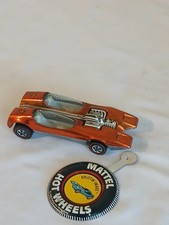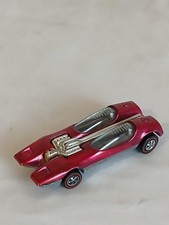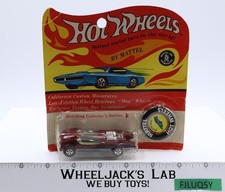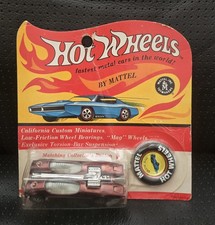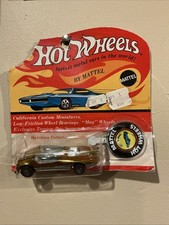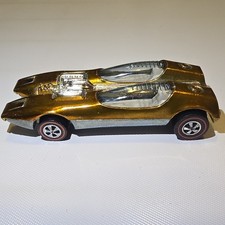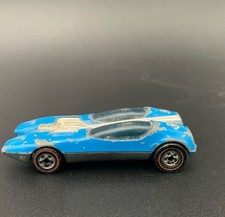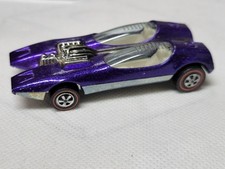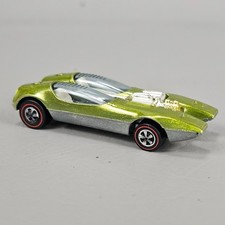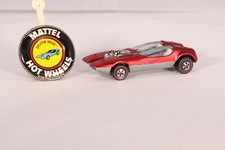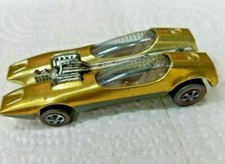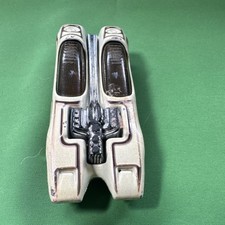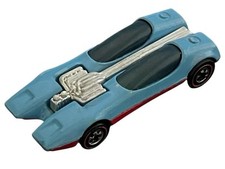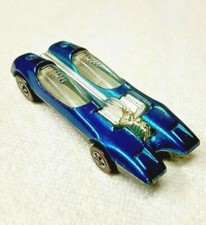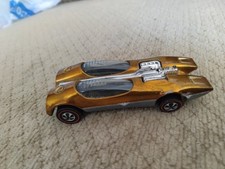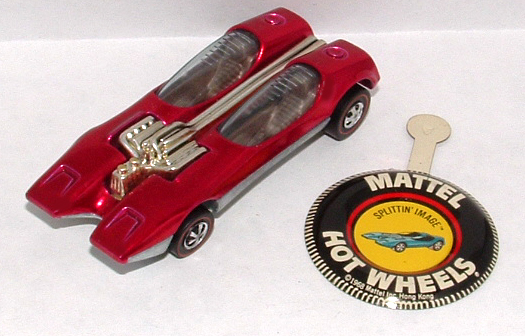
Casting #: 6261
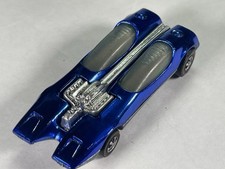
Splittin' Image
Designer: Ira Gilford
Production Run: 1969-1971
Note: Produced only in the U.S. One of the more affordable castings on the market today.
Picture and description thanx to NCHWA.comOpenAI/ChatGPT Collector Guide
1969 Hot Wheels Redline Splittin Image Collector Guide
Quick Value Snapshot
| Category |
Collector Notes |
| Model |
1969 Hot Wheels Redline Splittin' Image |
| Designer |
Ira Gilford |
| Production run |
1969 to 1971 |
| Production location |
Produced only in the U.S. |
| Wheel setup |
2 medium Redline wheels and 2 small Redline wheels |
| General market position |
Generally one of the more affordable original Redline castings, depending heavily on condition, color, originality, and packaging. |
| Pricing confidence |
Limited without verified recent sold examples. Active asking prices should not be treated as confirmed market value. |
Collector Summary
The 1969 Hot Wheels Redline Splittin' Image is an original-era Redline casting designed by Ira Gilford and produced from 1969 through 1971. It is a futuristic concept-style design with a low, split-body appearance that reflects Mattel's late-1960s custom show-car influence.
Among original Redlines, the Splittin' Image is usually considered a more accessible casting. That does not mean every example is inexpensive. Strong color, clean Spectraflame finish, bright chrome, correct wheels, an unaltered base, and original packaging can all raise collector interest. Conversely, wear, reproduction parts, poor restoration, wheel swaps, and incorrect listings can sharply reduce value.
Known Variations and Details
- Designer: Ira Gilford.
- Production run: 1969-1971.
- Country of production: U.S. production only, according to the supplied database notes.
- Wheel configuration: 2 medium Redline wheels and 2 small Redline wheels.
- Era: Original Hot Wheels Redline period.
- Style: Futuristic custom concept car with a split central body theme.
- Finish: Original examples are found with period Hot Wheels finishes; collectors should verify that color, tone, and shine are consistent with original Spectraflame-era production.
Because the Splittin' Image was produced over multiple years, small production differences may exist. Advanced collectors should compare base details, wheel type, interior color, glass color, and finish quality against trusted Redline references before assigning a premium.
Color and Desirability Notes
Color is an important factor, but it should not be evaluated alone. A clean common-color example can be more desirable than a rarer-color example with heavy play wear, dull paint, corrosion, broken parts, or replaced wheels.
- Common colors: More frequently seen colors tend to keep this casting affordable, especially in average played-with condition.
- Less common colors and shades: Unusual shades, strong color intensity, and high-gloss original finish can attract more collector attention, but claims should be verified carefully.
- Toning and fading: Spectraflame finishes can change over time. Fading, uneven tone, and color shift may affect desirability.
- Originality matters: Repainted or polished examples should not be compared directly with untouched original cars.
Condition Factors That Affect Value
- Paint condition: Edge wear, roof wear, nose chips, side wear, and rear-end wear are common on played-with Redlines.
- Spectraflame brightness: Bright, even, original paint is preferred. Dull or heavily oxidized finish usually lowers desirability.
- Base condition: Tarnish, corrosion, heavy scratching, or signs of tampering can reduce value.
- Wheels: Correct Redline wheels are important. Wheel swaps, cracked wheels, missing caps, and bent axles should be disclosed.
- Axles: Straight axles with smooth rolling action are preferred, though many collectors prioritize originality over perfect rolling.
- Interior and glass: Cracks, melt marks, missing parts, or replacements should be noted.
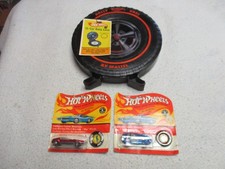
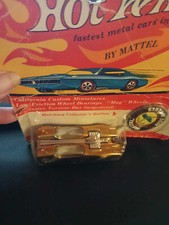
- Packaging: Original blister card examples are evaluated separately from loose cars. Card condition, bubble clarity, cracks, lifting, and reseal evidence matter.
- Restoration status: Restored examples are not equivalent to original examples and should be priced and described separately.
Restorer Notes
The Splittin' Image is a practical casting for restoration practice because it is generally more available than many higher-demand Redlines. However, restoration work should be clearly disclosed when selling or documenting the car.
- Do not represent a restored Splittin' Image as an original survivor.
- Reproduction wheels, reproduction glass, replacement interiors, and repainted finishes should be identified.
- Polishing an original base or repainting a lightly worn car may reduce collector value for buyers who prefer untouched examples.
- For restoration accuracy, match the wheel sizes to the correct 2 medium and 2 small Redline wheel setup.
- Before repainting, confirm whether the original color or variation has collector significance.
Buyer Cautions
- Separate asking prices from sold prices: A high active listing does not prove market value.
- Check originality: Look for repaint signs, replacement wheels, reproduction parts, polished bases, and opened rivets.
- Verify the casting: Do not rely only on listing titles. Confirm the car is actually the Splittin' Image and not a later reissue, custom, or wrong-casting listing.
- Inspect photos carefully: Ask for clear photos of the top, sides, front, rear, base, wheels, axles, interior, and glass.
- Be cautious with vague wording: Phrases such as "looks mint," "rare color," or "from estate" are not substitutes for condition details.
- Packaging claims need proof: For carded examples, examine bubble sealing, card wear, cracks, lifting, and any signs of resealing.
- Do not compare restored cars to originals: Restored or customized examples belong in a separate pricing category.
Seller Notes
- State the model clearly as a 1969-era Hot Wheels Redline Splittin' Image.
- Disclose whether the car is original, restored, customized, or assembled from parts.
- Photograph the base and wheels clearly, including the 2 medium and 2 small wheel configuration.
- Describe paint wear honestly, including chips, fading, toning, dullness, corrosion, or body damage.
- If selling a carded example, include clear photos of the bubble edges, card back, hanger area, and any cracks or lifting.
- Use recent verified sold prices as a guide, not active asking prices alone.
- Avoid calling a color rare unless it can be supported by recognized Redline references or strong collector consensus.
Pricing Analysis
The Splittin' Image is generally one of the more affordable original Redline castings. That broad statement applies mainly to loose, played-with examples in more commonly seen colors. Higher-grade original examples, desirable colors, and original carded examples must be evaluated separately.
| Pricing Source |
How to Use It |
Caution |
| Active asking prices |
Useful for seeing what sellers hope to get. |
Do not treat asking prices as market value. Unsold listings may be overpriced or may lack buyer confidence. |
| Actual sold prices |
Best indicator of current market behavior when the item is correctly identified and comparable. |
Confirm that the sold example was original, complete, correctly described, and not part of a mixed lot. |
| Price guides |
Helpful for general ranking and historical context. |
Guides may lag behind current market conditions and may not reflect condition-specific results. |
| Dealer prices |
Useful when condition and originality are well documented. |
Dealer pricing may include convenience, vetting, return policy, or presentation premium. |
Pricing confidence is limited when only thin or non-verified data is available. Strong outliers should be reviewed separately. A very high sale may involve exceptional condition, rare color, original packaging, or buyer-specific demand. A very low sale may involve damage, poor photos, incorrect title, restoration, missing parts, or a lot listing that obscured the true value of the car.
Listings to Exclude or Treat Carefully
- Repainted cars presented without clear restoration disclosure.
- Customs, fantasy restorations, or heavily modified examples.
- Cars with reproduction wheels, reproduction glass, or replacement interiors unless clearly described.
- Mixed lots where the value of the Splittin' Image cannot be isolated.
- Damaged examples with broken glass, missing parts, bent axles, crushed bodies, or severe corrosion.
- Wrong-casting listings using the Splittin' Image name incorrectly.
- Later reissues or anniversary versions listed as original Redlines.
- Listings with poor photos that hide the base, wheels, or condition issues.
- Carded examples with possible reseals, replaced bubbles, or unclear packaging photos.
New Collector Advice
The Splittin' Image is a good entry point into original Redline collecting because it is usually more affordable than many other early castings. For a first example, focus on originality, clean wheels, decent paint, and a fair price based on actual sold examples.
- Buy the best original condition you can comfortably afford.
- Learn the difference between original wear and restoration work.
- Do not pay a premium for a color claim unless you can verify it.
- Ask for base and wheel photos before buying.
- Compare only similar examples: loose to loose, carded to carded, restored to restored, and original to original.
Advanced Collector Notes
Advanced collectors should evaluate the Splittin' Image beyond the basic casting name. Important review points include color shade, finish intensity, base condition, wheel correctness, interior and glass originality, and production-period details. Because the model was produced from 1969 to 1971, careful comparison across known examples can help identify meaningful variation versus normal production inconsistency.
- Document shade differences with consistent lighting.
- Compare base markings and rivet appearance for signs of tampering.
- Check whether wheel wear is consistent with body wear.
- Separate exceptional original examples from restored display pieces.
- For high-grade or unusual-color examples, preserve provenance and purchase records when available.
Short Page Blurb
The 1969 Hot Wheels Redline Splittin' Image is a U.S.-produced Ira Gilford design made from 1969 to 1971. Known for its futuristic split-body styling and 2 medium/2 small Redline wheel setup, it remains one of the more approachable original Redline castings, with value driven by originality, color, condition, and packaging.
Disclaimer
This guide is for collector reference only. Values can change over time and depend on condition, originality, color, packaging, buyer demand, and the quality of available evidence. Active asking prices are not the same as actual sold prices. Repaints, customs, restorations, reproduction parts, damaged cars, lots, and wrong-casting listings should not be treated as normal value examples. No exact value is guaranteed.
Gemini/Google AI Collector Guide
1969 Hot Wheels Redline Splittin Image Collector Guide
Quick Value Snapshot
| Condition |
Common Colors (Aqua, Green, Antifreeze) |
Rare Colors (Rose, Purple, Pink) |
| Beater / Heavy Play Wear |
$10 - $25 |
$30 - $60 |
| Good / Average (Visible Chips) |
$30 - $55 |
$70 - $120 |
| Excellent / Near Mint |
$60 - $110 |
$150 - $350+ |
Collector Summary
The Splittin' Image is an iconic "fantasy" design from the second year of Hot Wheels production (1969). Designed by Ira Gilford, the car is famous for its twin-cockpit layout and the chrome exhaust pipes that wrap around the rear of the body. According to production records, this casting was produced exclusively in the United States. It remains one of the more affordable and accessible castings for collectors due to its high production volume between 1969 and 1971.
Known Variations and Details
- Production Era: 1969–1971.
- Origin: United States (U.S.) only. No Hong Kong versions are known to exist.
- Wheel Configuration: 2 Medium wheels in the rear, 2 Small wheels in the front.
- Base: Silver-painted or unpainted metal base (U.S. style).
- Interior/Canopy: Features a plastic canopy that covers the dual cockpits, usually found with a blue-tinted or clear-to-light-smoke appearance.
Color and Desirability Notes
Because the Splittin' Image was only produced in the U.S., it features the standard range of Spectraflame colors. The most common colors are Lime, Green, Antifreeze, and Aqua. Blue and Red are slightly less common but still frequently seen. Rare colors that significantly drive up value include Rose, Purple, Brown, and the highly elusive "Creamy Pink."
Condition Factors That Affect Value
- The Canopy: The plastic canopy is prone to scratching, "fogging," or cracking. A crystal-clear, undamaged canopy is essential for a premium price.
- Exhaust Chrome: The wrap-around exhaust pipes are often subject to "chrome rub" where the silver plating wears off, revealing the grey plastic or metal underneath.
- Edge Wear: The sharp lines of the fenders and the "split" in the middle are the first places to lose paint.
- Toning: Like many U.S. cars, the Spectraflame paint can "tone" (darken or become blotchy) over time due to the oxidation of the zinc alloy beneath the paint.
Restorer Notes
The Splittin' Image is a popular choice for beginner restorers because of its relatively simple assembly. However, the wrap-around exhaust part is delicate. If the canopy is cracked, it must be replaced with a reproduction part, which should always be disclosed if the car is being sold. Collectors generally prefer original "survivor" paint over a perfect restoration.
Buyer Cautions
When purchasing online, be wary of "over-lighting" in photos. Bright lights can make a heavily toned car look like a rare color (e.g., a toned Aqua looking like a rare Green). Always ask for a photo of the base to ensure it is an original Redline-era casting and not a later reissue from the 1990s or 2000s.
Seller Notes
This is a high-volume casting. If you are selling a common color (like Green or Aqua) in played-with condition, expect high competition from other sellers. To get top dollar, emphasize the clarity of the canopy and the lack of "foxy" toning in the paint. High-resolution photos of the rear exhaust chrome are also vital for serious buyers.
Pricing Analysis
While asking prices on many platforms frequently exceed $100 for average examples, actual sold prices for common colors in "good" condition typically settle in the $30 to $50 range. Confidence in the current market for this casting is high because it is a staple of early Hot Wheels collections. Outliers include "NIP" (New in Package) examples or rare colors like Purple, which can deviate significantly from the "affordable" baseline.
Listings to Exclude or Treat Carefully
- Repaints: Cars that have been stripped and repainted with modern Spectraflame-style paint.
- Vintage Series / Classics: Reissues from 1993 or 2005 often confuse new collectors. These have different wheel styles and base markings.
- Missing Canopies: A Splittin' Image without its canopy is generally considered a "parts car" with very low value.
New Collector Advice
The Splittin' Image is perhaps the best car for a new collector to start with. It embodies the 1960s "Space Age" design aesthetic of the original Hot Wheels team and can be found easily without spending hundreds of dollars. It allows you to learn the difference between various Spectraflame colors on a budget.
Advanced Collector Notes
Advanced collectors focus on "True Mint" examples or specific rare U.S. colors. Finding a Splittin' Image with a perfectly seated, scratch-free canopy and zero "chrome rub" on the exhaust is surprisingly difficult, even though the casting itself is common. Look for examples with "smooth" paint and no micro-spidering in the Spectraflame finish.
Short Page Blurb
The 1969 Splittin' Image, designed by Ira Gilford, is a quintessential U.S.-made Redline. Known for its dual-cockpit design and wrap-around exhausts, it remains an affordable favorite for collectors of all levels.
Disclaimer
Value guides are based on historical market trends and recent sales data. Actual market value may vary based on buyer demand, specific auction timing, and the subjective nature of condition grading. We do not guarantee specific prices or offer investment advice.
Online Redline Guide / Color Reference
Wheels: 2 Med, 2 Sm
US Colors
| Color | Comments |
|---|
| US COLORS : | COMMENTS: |
| antifreeze | common |
| aqua | common |
| blue | common |
| gold | common |
| green | common |
| orange | common |
| purple | common |
| red | common |
| copper brown | uncommon |
| dark brown | uncommon |
| "root beer" brown | uncommon |
| lime | uncommon |
| olive | uncommon |
| rose | uncommon |
| yellow | uncommon |
| creamy pink | hard to find |
| light blue | hard to find |
| magenta | very rare |
| SHELL PROMOS : | COMMENTS: |
| dark blue | uncommon |
| light blue | uncommon |
| red | uncommon |
| green | hard to find |
| fluorescent lime green | hard to find |
| yellow | rare |
| fluorescent pink | rare |
NCHWA.com Ratings
MINT Loose pricing below probably. Check ebay for blister pricing.
Note that these values are very old. Typical selling prices can be significantly higher now. Check the AI summaries for more info or ebay listings here.
Please see NCHWA.com Grading Page to reduce value due to condition.
| Color | US
Rating | US
Value | HK
Rating | HK
Value |
|---|
| Aqua | 1 | $23 | . | . |
| Blue | 1 | $23 | . | . |
| Green | 1 | $23 | . | . |
| Gold | 1 | $23 | . | . |
| Red | 1 | $23 | . | . |
| Orange | 1 | $23 | . | . |
| Antifreeze | 1 | $23 | . | . |
| Olive | 1+ | $30 | . | . |
| Purple | 1+ | $30 | . | . |
| Rose | 1+ | $30 | . | . |
| Lime | 1+ | $30 | . | . |
| Brown | 2 | $41 | . | . |
| Light Blue | 2 | $41 | . | . |
| Copper | 2+ | $50 | . | . |
| Yellow | 3 | $63 | . | . |
| Creamy Pink | 5 | $113 | . | . |
| Magenta | 9+ | $225 | . | . |
| | . | | . |
Looking for reproduction redline parts?

Total results 11
Average price for this page is $36