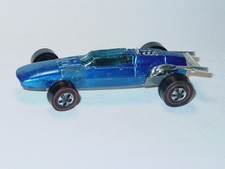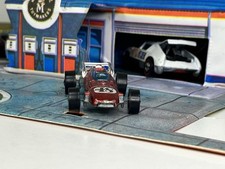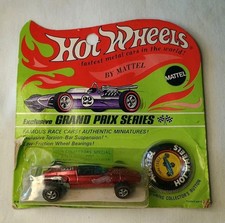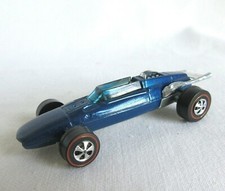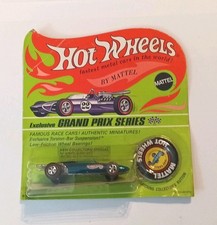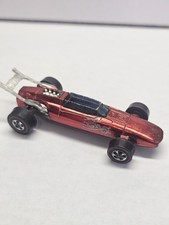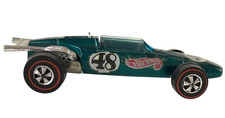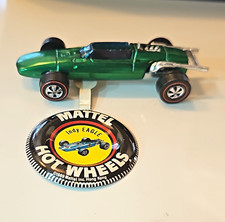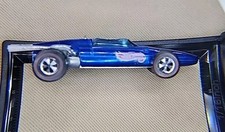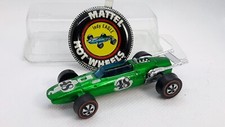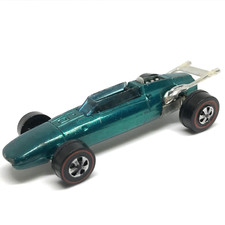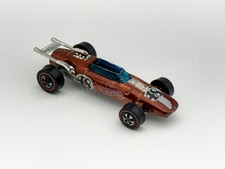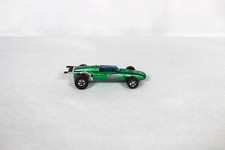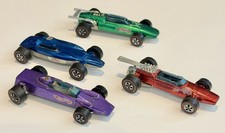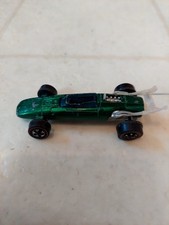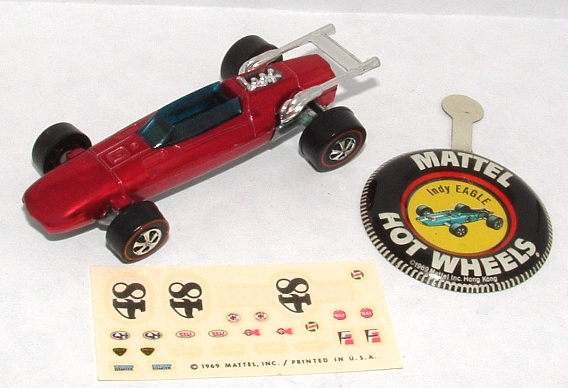
Casting #: 6263
Indy Eagle
Designer: Ira Gilford
Production Run: 1969-1971
Note: Grand Prix Series. Produced only in Hong Kong. Most versions come with a black interior, but variations exist with tan and white interiors as well. These do add a premium. There is also a very, very rare version that has twin plastic fuel tanks on either side. These may be considered prototypes, as they have never been found in blisterpack. Keep an eye out for the gold chrome version; while not rare, it is highly collectible.
Picture and description thanx to NCHWA.comOpenAI/ChatGPT Collector Guide
1969 Hot Wheels Redline Indy Eagle Collector Guide
Quick Value Snapshot
The 1969 Hot Wheels Redline Indy Eagle is a Grand Prix Series casting designed by Ira Gilford and produced from 1969 through 1971. It was produced only in Hong Kong and is a collector-recognized open-wheel Redline model.
- General demand: Steady among Redline collectors, especially those building 1969 Grand Prix Series runs.
- Common configuration: Hong Kong casting with black interior.
- Premium variations: Tan interior and white interior examples can bring added collector interest.
- Special note: Gold chrome examples are not considered rare, but they are highly collectible and often receive strong attention.
- Very rare feature: Twin plastic fuel tanks on each side are extremely uncommon and may be prototype-related, as they have not been confirmed in blisterpack.
- Value confidence: Exact pricing confidence is limited without reviewing current verified sold examples by color, condition, originality, and completeness.
Collector Summary
The Indy Eagle is one of the original-era Hot Wheels Redline open-wheel race cars and belongs to the 1969 Grand Prix Series. It was designed by Ira Gilford and produced from 1969 to 1971. Unlike some Redline castings that exist in both U.S. and Hong Kong production, the Indy Eagle was produced only in Hong Kong.
Most examples are found with a black interior. Tan and white interior variations are known and are more desirable to collectors because they are less frequently encountered. The casting is also notable for a very rare version with twin plastic fuel tanks mounted on either side. These fuel tank examples are generally treated with caution and special interest because they may be prototype pieces and have not been found in original blisterpack form.
Known Variations and Details
| Feature |
Known Detail |
Collector Importance |
| Designer |
Ira Gilford |
Important for historical documentation and casting attribution. |
| Production Run |
1969-1971 |
Places the model in the early Redline era. |
| Series |
Grand Prix Series |
Appeals to collectors building themed race car sets. |
| Country of Production |
Hong Kong only |
There is no standard U.S. production version to compare against. |
| Interior |
Usually black; tan and white variations exist |
Tan and white interiors generally add a premium when original. |
| Wheel Setup |
2 medium wheels, 2 small wheels |
Correct wheel sizing is important for originality. |
| Special Variation |
Twin plastic fuel tanks on both sides |
Extremely rare; possibly prototype-related and should be authenticated carefully. |
| Gold Chrome |
Known collectible version |
Not considered rare, but strongly collected. |
Color and Desirability Notes
The supplied collector notes specifically call out the gold chrome version as highly collectible. While it is not considered rare, gold chrome examples often attract attention because of their visual appeal and collector familiarity.
For any Indy Eagle, desirability depends heavily on originality, paint quality, base condition, wheel condition, and the presence of correct parts. Interior color also matters. Black interiors are the usual configuration, while tan and white interiors are less common and can add value when verified as original to the car.
Because early Hot Wheels Redlines were played with heavily, clean original examples are generally more desirable than worn examples. However, collectors should be careful not to assume that a bright finish alone proves originality, especially with chrome-like finishes, restored cars, or polished examples.
Condition Factors That Affect Value
- Original paint or finish: Original finish is critical. Repainted, polished, re-chromed, or restored examples should not be valued the same as untouched originals.
- Interior color: Black is most common. Tan and white interiors can add a premium if original.
- Wheel correctness: The correct setup is 2 medium wheels and 2 small wheels. Wheel swaps reduce collector value.
- Axle condition: Bent axles, sagging wheels, or poor rolling condition can reduce value.
- Base condition: Heavy toning, corrosion, scratches, or tool marks can affect desirability.
- Plastic parts: Any fragile or accessory-like components should be checked carefully for originality and damage.
- Fuel tank examples: Twin plastic fuel tank cars require careful authentication because of their rarity and possible prototype status.
- Blisterpack status: A genuine sealed example, if found, should be evaluated separately from loose cars. Fuel tank examples have not been confirmed in blisterpack according to supplied notes.
Restorer Notes
The Indy Eagle is a desirable restoration candidate when the original car is too worn for collector-grade display. However, restored examples should always be identified clearly as restored. A restored Indy Eagle should not be represented as an original mint car.
- Use correct wheel sizes: 2 medium wheels and 2 small wheels.
- Match the correct Hong Kong base style and casting features.
- Do not add rare-style features, such as twin fuel tanks, unless accurately documenting the work as a custom or restoration modification.
- Interior swaps can change the appearance and perceived rarity of the car. Sellers should disclose any replaced interior.
- Reproduction parts, replacement wheels, and restored finishes should be disclosed in any listing or collector record.
Buyer Cautions
- Do not treat asking prices as market value. Active listings show what sellers hope to receive, not necessarily what buyers are paying.
- Verify sold prices separately. Actual sold prices are more useful than active asking prices, but only when the example is original, correctly identified, and comparable in condition.
- Watch for restored cars. Repainted or refinished Indy Eagles can look attractive but should be priced differently from original examples.
- Check the interior color carefully. Tan and white interiors can command premiums, but only if original and correctly matched to the car.
- Be cautious with rare fuel tank claims. Twin plastic fuel tank examples are extremely rare and may be prototype-related. Authentication and provenance matter.
- Avoid wrong-casting comparisons. Do not use prices from other Grand Prix Series cars as direct Indy Eagle values unless clearly separated.
- Check wheel sizes. Incorrect replacement wheels reduce originality and should affect price.
Seller Notes
When selling a 1969 Hot Wheels Redline Indy Eagle, clear identification and honest condition reporting are important. Serious collectors will look closely at originality, wheel size, interior color, base condition, and any signs of restoration.
- State that the model is a Hong Kong-only casting.
- Identify the interior color clearly: black, tan, or white.
- Photograph both sides, top, base, front, rear, wheels, and interior.
- Disclose any restoration, repainting, wheel replacement, interior replacement, or reproduction parts.
- If the car is gold chrome, describe it accurately but avoid calling it rare unless there is another rare feature present.
- If the car has twin plastic fuel tanks, provide detailed photos and provenance if available. Treat it as a special-case listing rather than a normal loose Indy Eagle.
Pricing Analysis
Pricing for the Indy Eagle depends on condition, originality, interior color, finish, and completeness. Because no specific verified sold-price dataset is supplied here, exact value guidance should be treated with limited confidence. A proper pricing review should separate active asking prices from actual completed sales.
Active asking prices: These can be useful for seeing seller expectations and current availability, but they should not be treated as market value. High asking prices may sit unsold, especially for restored cars, incomplete examples, or listings with rare variation claims that are not proven.
Actual sold prices: Completed sales are more useful, but only when the sold example is comparable. A clean original black-interior car, a tan-interior car, a white-interior car, a gold chrome example, and a possible fuel tank prototype should not be averaged together as if they are the same item.
Outliers: Strong outliers may occur for unusually clean original examples, rare interior variations, sealed blisterpack cars, or cars claimed to have twin plastic fuel tanks. These should be analyzed separately and should not be used as normal value benchmarks.
Listings to Exclude or Treat Carefully
- Repainted or restored cars listed without clear disclosure.
- Custom cars or modified examples.
- Cars with reproduction parts or replaced interiors.
- Wheel-swapped examples using incorrect wheel sizes.
- Damaged cars with missing parts, heavy corrosion, or severe axle problems.
- Mixed lots where the Indy Eagle condition cannot be confirmed.
- Listings for the wrong casting or other Grand Prix Series models.
- Fuel tank examples without adequate photos, provenance, or collector verification.
- Active asking prices presented as if they were completed market sales.
New Collector Advice
For a first Indy Eagle, look for an original Hong Kong example with correct wheels, a clean base, and no obvious signs of repainting or repair. A black interior example is the typical version and is a good starting point for most collectors.
If you find a tan or white interior example, compare it carefully with known original examples and look for signs of interior swapping. If you find a gold chrome car, remember that it is collectible but not automatically rare. If you encounter a car with twin plastic fuel tanks, do not rush into treating it as a normal variation. That version is extremely rare and may require expert authentication.
Advanced Collector Notes
Advanced collectors should document interior color, wheel size, finish, base details, and any unusual construction features. Because the Indy Eagle was produced only in Hong Kong, variation study should focus less on U.S. versus Hong Kong differences and more on interior color, finish, wheel correctness, and special features.
The twin plastic fuel tank version is the most important advanced-level topic for this casting. Since these have not been found in blisterpack according to supplied collector notes, they should be treated as possible prototype or pre-production pieces rather than ordinary retail variations. Provenance, construction consistency, and comparison to known examples are especially important.
Short Page Blurb
The 1969 Hot Wheels Redline Indy Eagle is a Hong Kong-only Grand Prix Series casting designed by Ira Gilford and produced from 1969 to 1971. Most examples have black interiors, while tan and white interiors are premium variations. Gold chrome examples are highly collectible, and the extremely rare twin plastic fuel tank version may be prototype-related.
Disclaimer
This guide is for collector reference only and does not guarantee exact values. Prices can change based on condition, originality, color, interior, packaging, timing, and buyer demand. Active asking prices should not be treated as market value. Restored cars, customs, reproduction parts, damaged examples, mixed lots, and wrong-casting listings should be evaluated separately from original collector-grade examples.
Gemini/Google AI Collector Guide
1969 Hot Wheels Redline Indy Eagle Collector Guide
Quick Value Snapshot
Valuations for the Indy Eagle vary significantly based on paint condition and interior color. Generally, well-played examples can be found between $35 and $75. Near-mint specimens in common colors typically range from $150 to $350. Rare colors, such as Pink or Gold Chrome, and variations with Tan or White interiors can command significant premiums exceeding $500+ depending on the market at the time of sale.
Collector Summary
The Indy Eagle was designed by Ira Gilford and released as part of the 1969 Grand Prix Series. It is based on the famous open-wheel racers driven by Dan Gurney. This casting was produced exclusively in the Hong Kong factory, which is reflected in its blue-tinted windows and specific wheel style. It had a production run from 1969 through 1971. Because it is an open-wheel racer, it is particularly susceptible to bent axles and damage to the exposed plastic engine components.
Known Variations and Details
- Production Origin: Hong Kong only.
- Interior Colors: Black is the standard production color. Tan and White interiors exist and are considered high-premium variations.
- Twin Fuel Tank Prototype: A legendary and extremely rare version features plastic fuel tanks on both sides of the body. These have not been found in original blisterpacks and are widely considered to be prototypes or pre-production pieces.
- Wheel Configuration: Equipped with two small wheels in the front and two medium wheels in the rear.
- Gold Chrome Version: While not as rare as the prototype, the Gold Chrome version is a specific, highly sought-after collectible that stands apart from the standard Spectraflame colors.
Color and Desirability Notes
The Indy Eagle was released in a wide variety of Spectraflame colors. Common colors include Blue, Aqua, Red, and Green. More desirable and harder-to-find colors include Pink, Rose, and Purple. The Gold Chrome version is often considered a "must-have" for Grand Prix series completists. When assessing desirability, collectors prioritize paint "pop" (vibrancy) and the presence of original decals (roundels/numbers), which were often applied by the original owners.
Condition Factors That Affect Value
- Plastic Engine/Exhaust: This piece is often missing or has broken "pipes." An original, intact engine is critical for top-tier value.
- Axle Straightness: As an open-wheel car, the thin wire axles are often bent, causing the car to "lean" or sit poorly.
- Toning: Like many Hong Kong castings, the paint can "tone" or darken over time due to the metal alloy used. Bright, consistent color is preferred.
- Decal Integrity: Original numbers and stickers add value if they are clean and centered, though many collectors prefer "clean" cars over those with poorly applied or peeling original decals.
Restorer Notes
The Indy Eagle is a popular candidate for restoration due to the availability of reproduction engines and decals. Because the engine is a separate plastic piece, it is easily replaced; however, a serious collector will always check to see if the engine is an original Hong Kong part or a modern reproduction. Restorers should be careful when straightening the delicate axles, as the Hong Kong wire can be brittle.
Buyer Cautions
Watch for "tribute" cars being sold as original prototypes. Because the twin fuel tank version is so valuable, some unscrupulous sellers may attempt to glue reproduction tanks onto a standard body. Always verify the source and look for signs of glue or paint tampering. Additionally, check closely for "repro" engines; while they look good, they should be disclosed by the seller as they affect the historical value of the piece.
Seller Notes
When listing an Indy Eagle, it is vital to photograph the interior clearly. If you have a tan or white interior, highlight this in the title, as it significantly increases the pool of interested advanced collectors. Be sure to show the car from the side at eye-level to prove the axles are straight and the car sits level. Mention if the engine/exhaust piece is original or a replacement.
Pricing Analysis
Market confidence for the Indy Eagle is high for standard colors and black interiors due to the high volume of sales data. Confidence is lower for the "Twin Fuel Tank" prototype and the rarest Spectraflame colors because these items appear on the market very infrequently. Active asking prices on auction sites are often optimistic and can sit 20-40% higher than actual sold prices. Always look for "Sold" listings to determine the current liquid market value.
Listings to Exclude or Treat Carefully
- Repaints/Customs: These should not be compared to original Spectraflame prices.
- Missing Engines: These cars should be valued as "parts cars" or restoration projects only.
- Wrong Casting: Do not confuse the Indy Eagle with the later 1970s "Formula P.A.C." or other open-wheel castings.
- "Lot" Prices: Listings where the Indy Eagle is sold as part of a large group of cars often reflect a wholesale price rather than a single-item collector value.
New Collector Advice
The Indy Eagle is a great entry point into the Grand Prix series. It is relatively easy to find in mid-grade condition. A new collector should focus on finding a car with a solid, original engine and straight axles first, then worry about finding rare colors later. Avoid buying cars with "pitted" chrome on the engine unless the price is very low.
Advanced Collector Notes
For the advanced collector, the hunt is for the white interior variation and the elusive fuel-tank prototype. Finding a Hong Kong Indy Eagle with a vibrant, non-toned Pink or Purple paint job is also a significant challenge. Collectors should also look for "unapplied decal sheet" examples, though these are extremely rare for this specific casting.
Short Page Blurb
The 1969 Indy Eagle is a staple of the Hot Wheels Grand Prix series. Designed by Ira Gilford and produced only in Hong Kong, this open-wheel racer is famous for its fragile engine detail and rare interior variations. Whether you are looking for the common black-interior version or the ultra-rare twin fuel tank prototype, the Indy Eagle remains a centerpiece of the early Redline era.
Disclaimer
Historical price data is for informational purposes only. RedlinePriceGuide.com does not guarantee exact values, as the market for vintage collectibles fluctuates based on demand, platform, and individual buyer preference. Always perform your own due diligence before buying or selling.
Online Redline Guide / Color Reference
Wheels: 2 Med, 2 Sm
US Colors
| Color | Comments |
|---|
| Color Normal White Interior | Aqua |
| Red | Common |
| Green | Common |
| Blue | Less Common |
| Purple | Less Common |
| Olive | Less Common |
| Orange | Less Common |
| Gold Chrome | Hard to Find |
| Rose | Hard to Find - |
| Brown | unknown |
NCHWA.com Ratings
MINT Loose pricing below probably. Check ebay for blister pricing.
Note that these values are very old. Typical selling prices can be significantly higher now. Check the AI summaries for more info or ebay listings here.
Please see NCHWA.com Grading Page to reduce value due to condition.
| Color | US
Rating | US
Value | HK
Rating | HK
Value |
|---|
| Aqua | . | . | 1 | $23 |
| Green | . | . | 1 | $23 |
| Red | . | . | 1 | $23 |
| Blue | . | . | 1 | $23 |
| Orange | . | . | 2- | $31 |
| Purple | . | . | 2 | $41 |
| Olive | . | . | 2+ | $50 |
| Copper | . | . | 3- | $51 |
| Brown | . | . | 3 | $63 |
| Gold Chrome | . | . | 4 | $88 |
Looking for reproduction redline parts?

Total results 6
Average price for this page is $10