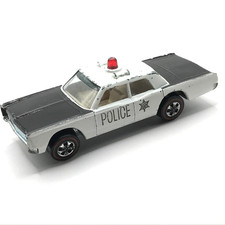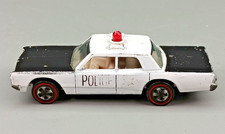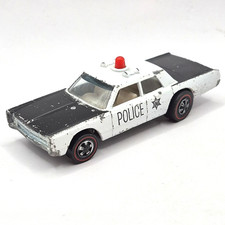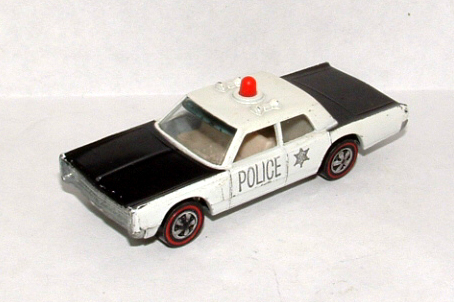
Casting #: 6269
Custom Police Cruiser
Designer: Ira Gilford
Production Run: 1969-1971
Note: Produced only in the U.S. The dome light has been found both in solid and translucent red. No premium is added for this variation. However, a valuable variation does exist where the fenders are painted black, along with the trunk and hood (pic here). An even rarer variation is blue paint replacing the black, but this is considered a prototype. This model marks the first use of a tampo on a Hot Wheels car, where the word "Police" and the shield are stamped on.
Picture and description thanx to NCHWA.comOpenAI/ChatGPT Collector Guide
1969 Hot Wheels Redline Custom Police Cruiser Collector Guide
Quick Value Snapshot
| Version or Situation |
Collector Value Impact |
Pricing Confidence |
| Standard Custom Police Cruiser |
Desirable 1969 Redline casting with added interest as the first Hot Wheels model to use a tampo-style stamped graphic. |
Moderate, when based on verified sold examples in comparable condition. |
| Solid red dome light |
No normal premium over the translucent red dome light version. |
Good. |
| Translucent red dome light |
No normal premium over the solid red dome light version. |
Good. |
| Black fender variation |
Valuable variation when the black fender paint is original and correctly authenticated. |
Limited; treat individual sales carefully. |
| Blue paint replacing the black areas |
Considered a prototype-level variation, not a normal production value comparison. |
Very limited. |
| Restored, repainted, customized, or reproduction-part examples |
Should not be used as normal value examples for original cars. |
Case-by-case only. |
Collector Summary
The 1969 Hot Wheels Redline Custom Police Cruiser was designed by Ira Gilford and was produced from 1969 through 1971. It was produced only in the United States. The casting is important to Redline collectors because it marks the first use of a tampo-style stamped decoration on a Hot Wheels car, with the word Police and the shield applied to the body.
For most collectors, value is driven by originality, paint condition, wheel condition, base condition, and the quality of the original police graphics. The standard version is collectible on its own, while the black fender variation is the major production variation to watch for. The blue-painted variation replacing the black areas is generally considered a prototype and should not be priced like a normal production car.
Known Variations and Details
- Designer: Ira Gilford.
- Production run: 1969-1971.
- Country of production: United States only.
- Wheel setup: 4 medium Redline wheels.
- Dome light: Found in both solid red and translucent red. This variation does not normally add a premium.
- Police graphics: The word Police and the shield are stamped on the car, making this casting significant as the first Hot Wheels use of this decoration method.
- Black fender variation: A valuable variation exists with the fenders painted black, along with the trunk and hood. Originality is critical when evaluating this version.
- Blue prototype-style variation: An even rarer version is known with blue paint replacing the black. This is considered a prototype rather than a regular production variation.
Color and Desirability Notes
The Custom Police Cruiser is not collected in the same way as many Spectraflame Redlines because its appeal is tied strongly to its police decoration, U.S.-only production, and historically important tampo-style marking. Collectors should focus less on minor dome-light differences and more on overall originality and condition.
The standard production car is desirable when clean and complete, especially with strong original graphics. The black fender variation is much more sought after, but it must be evaluated carefully because added black paint, touch-ups, and restorations can be mistaken for a legitimate variation. The blue-painted prototype-style variation is outside normal market comparison and should be treated as a specialized research or advanced-collector item.
Condition Factors That Affect Value
- Original paint: Chips, scratches, edge wear, rubs, and repainting all reduce value.
- Police tampo/stamp quality: The word Police and shield should be present and original. Heavy wear, fading, scraping, or reproduction graphics affect desirability.
- Dome light: The dome light should be present and original. Solid red and translucent red are both known, with no normal premium for either.
- Wheels: The car should have four medium Redline wheels. Bent axles, replaced wheels, cracked wheels, missing redlines, or poor rolling condition affect value.
- Base: A clean original base is preferred. Heavy toning, corrosion, pry marks, polishing, or evidence of disassembly should be disclosed.
- Glass and interior: Cracks, melt marks, clouding, or missing parts reduce value.
- Black fender verification: For the valuable black fender version, collectors should look closely for consistent original paint, correct aging, and no signs of later hand-applied paint.
- Packaging: Original blister packaging, if present, should be evaluated separately from loose-car pricing. Card condition, blister clarity, cracks, lifting, and originality matter.
Restorer Notes
The Custom Police Cruiser is often restored because the police graphics, roof light, and black-painted areas make worn examples visually appealing restoration candidates. Restored cars can be enjoyable display pieces, but they should not be priced or described as original examples.
- Reproduction decals or graphics must be disclosed.
- Replacement dome lights should be disclosed.
- Wheel swaps should be disclosed, even if the wheels are correct medium Redline style.
- Touch-ups to black areas, fenders, hood, or trunk should be disclosed.
- A restored black fender-style car is not the same as an original black fender variation.
Buyer Cautions
- Do not treat asking prices as market value. Active listings can be optimistic and may remain unsold for long periods.
- Use sold prices only when possible. Compare only original cars in similar condition.
- Be cautious with black fender claims. This is the major valuable variation, so it is also the version most likely to be misidentified, touched up, or recreated.
- Do not pay extra for the dome-light difference alone. Solid red and translucent red dome lights are both known and no normal premium is assigned to either.
- Watch for reproduction parts. Dome lights, wheels, and graphics may be replaced on restored examples.
- Avoid wrong comparisons. Lots, customs, repaints, restored cars, damaged cars, and listings with uncertain originality should not be used as normal value examples.
- Prototype claims require proof. A blue-painted version replacing the black areas should be treated as a prototype-level claim and requires strong provenance or expert review.
Seller Notes
- Photograph the car from all sides, including roof, hood, trunk, fenders, base, wheels, dome light, and close-ups of the police graphics.
- State whether the car is original, restored, touched up, or uncertain.
- Identify the dome light as solid red or translucent red, but do not imply that this alone creates a premium.
- If selling a black fender variation, provide clear close-up photos and describe why you believe the paint is original.
- Separate the value of any packaging, button, or accessory from the loose car unless selling as a complete original package.
- Use actual sold comparisons rather than active asking prices when setting expectations.
Pricing Analysis
Pricing confidence for the standard Custom Police Cruiser is strongest when comparing verified sold examples that are original, complete, and in similar condition. Active asking prices should be treated only as seller expectations, not confirmed market value.
The standard version generally follows normal Redline condition rules: cleaner paint, stronger graphics, better wheels, and original parts bring more interest. Heavy play wear, missing or replaced parts, poor wheels, and damaged graphics reduce value.
The black fender variation should be analyzed separately from standard cars. It is a valuable variation, but only when the black fender paint is original. Because added black paint can imitate the look, pricing should depend on authentication, condition, and buyer confidence. Thin sales data and possible outliers mean confidence is limited.
The blue paint variation replacing the black areas should not be priced from ordinary production-car data. It is considered a prototype, and prototype-level items require separate provenance, expert review, and a much smaller pool of comparable sales.
Listings to Exclude or Treat Carefully
- Active asking-price listings with no confirmed sale.
- Group lots where the individual Custom Police Cruiser value cannot be separated.
- Restored, repainted, customized, or clear-coated cars.
- Cars with reproduction police graphics, reproduction dome lights, or replacement wheels unless clearly disclosed.
- Damaged examples with missing parts, broken glass, severe corrosion, or altered bases.
- Wrong-casting or misidentified police car listings.
- Black fender listings without clear photos or evidence that the paint is original.
- Prototype claims without provenance or specialist confirmation.
New Collector Advice
If you are new to Redlines, start by learning the standard Custom Police Cruiser before chasing the black fender variation. Look for an original, complete car with presentable paint, intact dome light, correct medium Redline wheels, and clear police graphics. Do not pay extra for the solid versus translucent dome light difference alone.
When comparing prices, use sold listings and compare condition carefully. A worn original car, a restored car, and a high-grade original car can all look similar in small photos but have very different collector value.
Advanced Collector Notes
Advanced collectors should focus on originality indicators, especially on the black fender variation. The key question is whether the black fender paint is factory-applied and naturally aged with the rest of the car. Examine paint edges, texture, wear patterns, gloss, and consistency with the hood and trunk areas.
The blue-painted version replacing the black is best treated as a prototype subject. It should be documented separately from regular production variations and should not be valued using standard Custom Police Cruiser comparisons.
Because this casting represents the first use of a tampo-style stamped graphic on a Hot Wheels car, high-grade examples with strong original police markings have added historical appeal beyond normal casting popularity.
Short Page Blurb
The 1969 Hot Wheels Redline Custom Police Cruiser, designed by Ira Gilford, was produced in the U.S. from 1969-1971 and is notable as the first Hot Wheels car to use a tampo-style stamped graphic. Dome lights are found in solid and translucent red with no normal premium. The major production variation is the valuable black fender version, while the blue-painted version replacing the black is considered a prototype.
Disclaimer
Values for Hot Wheels Redlines vary by condition, originality, timing, venue, and buyer demand. Active asking prices are not the same as actual sold prices. Restored cars, repaints, customs, reproduction parts, damaged examples, lots, and misidentified listings should not be used as normal price comparisons. Exact values are not guaranteed, and rare variations or prototype-level examples require careful authentication.
Gemini/Google AI Collector Guide
1969 Hot Wheels Redline Custom Police Cruiser Collector Guide
Quick Value Snapshot
| Condition |
Estimated Sold Price Range |
| Poor / Play-Worn (Heavy paint loss, missing dome light) |
$25 - $60 |
| Good / Very Good (Visible wear, intact tampos, intact light) |
$75 - $150 |
| Excellent to Near Mint (Bright white, crisp tampos, no toning) |
$200 - $450+ |
| Rare Black/White Variation (Condition dependent) |
$1,200 - $3,500+ |
Collector Summary
The Custom Police Cruiser, designed by Ira Gilford and produced from 1969 to 1971, holds a significant place in Hot Wheels history. This model marks the very first use of a tampo (pad print) on a Hot Wheels car, featuring the "Police" text and shield on the doors. Unlike most Redlines of the era which featured Spectraflame paint, the Police Cruiser was primarily produced in a white enamel finish. It was produced exclusively at the United States plant.
Known Variations and Details
- Standard White: The most common version, featuring an all-white body with a black interior.
- Dome Light Variations: The roof-mounted siren/dome light is found in two versions: solid red plastic and translucent red plastic. Currently, collectors do not place a significant price premium on one over the other.
- Black & White Variation: A highly sought-after and valuable variation where the fenders, trunk, and hood are painted black, mimicking a traditional "black and white" patrol car.
- Blue Prototype: An extremely rare variation exists where blue paint replaces the black on the "black and white" scheme. This is generally classified as a prototype and rarely enters the open market.
- Base/Wheels: The car features a zinc-plated base and four medium-sized Redline wheels.
Color and Desirability Notes
While the standard color is white enamel, the desirability of a specific example is driven largely by the condition of the white paint. White enamel from this era is prone to "toning," where the paint takes on a yellowish or brownish hue over time due to environmental factors or oxidation of the metal underneath. A "bright white" example with no toning is highly desirable. The Black & White variation is considered a "grail" piece for many Redline enthusiasts.
Condition Factors That Affect Value
- Tampo Integrity: Because these were the first tampos, they are often found scratched or partially rubbed off. Crisp, 100% complete "Police" shields are essential for top-tier pricing.
- Toning: Collectors pay a premium for cars that have remained bright white. Heavy yellowing significantly reduces the value.
- The Dome Light: The small red light on the roof is often missing, chipped, or melted. A perfectly seated, undamaged light is required for a car to be considered "Near Mint."
- Roof Pillars: Like many sedans of this era, the pillars can be prone to bending or "A-pillar" cracks if the car was stepped on or crushed in a toy box.
Restorer Notes
Restoring a Custom Police Cruiser is challenging because of the tampos. While reproduction decals are available, they do not perfectly replicate the look of the original 1969 tampo process. Original dome lights are difficult to source; many restorers resort to reproduction resin lights, which should always be disclosed upon resale. Because the car is white enamel, matching the specific "warmth" of 1960s white paint can be difficult compared to modern bright whites.
Buyer Cautions
Faked Variations: Given the high value of the Black & White variation, buyers should be wary of standard white cars that have been masked and painted black by restorers to mimic the rare version. Examine the paint edges around the fenders and hood under magnification; original factory paint should show consistent aging and a specific "flow" at the color breaks. Faded Tampos: Be careful of listings where the photos are overexposed, which can hide the fact that the "Police" tampo is faded or mostly gone.
Seller Notes
When selling, high-resolution photos of the door tampos and the roof light are mandatory. If the car has no yellowing (toning), mention "no toning" in the description and photograph the car against a neutral grey background to prove the whiteness of the paint. Clearly state whether the dome light is solid or translucent, as some specialized collectors may be looking for one specifically to complete a set.
Pricing Analysis
The market for the standard white Custom Police Cruiser is stable, with high-quality examples consistently fetching strong prices. Confidence in pricing for the standard model is high. However, confidence for the Black & White variation and the Blue prototype is limited due to the low frequency of public sales; these items often sell through private treaty or high-end auction houses where prices can fluctuate wildly based on the presence of two or more competing "deep pocket" bidders.
Listings to Exclude or Treat Carefully
- Restored/Code 3 Cars: These should not be compared to original factory paint examples.
- Missing Lights: A car missing its dome light should be valued significantly lower, often as "parts only" or a restoration candidate.
- Worn Tampos: If the "Police" wording is unreadable, the car loses its primary historical appeal and should be priced as a "beater."
New Collector Advice
If you are just starting, look for a standard white version with a clean dome light and at least 80% of the tampo intact. Do not overpay for "solid vs translucent" light variations, as they are currently valued similarly. This is a foundational piece for any Hot Wheels collection because it represents the birth of the tampo printing process that defines the brand today.
Advanced Collector Notes
For the advanced collector, the focus is on "The Three Ts": Toning, Tampoes, and Transparent lights. Finding a white cruiser that has survived 50+ years without the paint turning yellow is the ultimate goal. For those chasing the Black & White variation, provenance is key; ensure the paint is original factory applied before committing to a high-value purchase.
Short Page Blurb
The 1969 Custom Police Cruiser is a landmark Hot Wheels release, being the first model to feature tampo-printed graphics. Produced only in the U.S. and famously designed by Ira Gilford, this enamel-painted cruiser is a must-have for historians and Redline enthusiasts alike.
Disclaimer
Historical price data is for informational purposes only. Market values fluctuate based on demand, auction platform, and specific item nuances. RedlinePriceGuide.com does not guarantee future value or investment returns. Always verify the authenticity of rare variations before purchase.
Online Redline Guide / Color Reference
NCHWA.com Ratings
MINT Loose pricing below probably. Check ebay for blister pricing.
Note that these values are very old. Typical selling prices can be significantly higher now. Check the AI summaries for more info or ebay listings here.
Please see NCHWA.com Grading Page to reduce value due to condition.
| Color | US
Rating | US
Value | HK
Rating | HK
Value |
|---|
| White/Black enamel | 2 | $41 | . | . |
| White/Black (w/black fenders | 25 | $1,001 | . | . |
| White/Blue (w/blue fenders | 38 | $4,201 | . | . |
| | . | | . |
Looking for reproduction redline parts?

Total results 1