1969 Hot Wheels Redline Chaparral 2G Collector Guide
Quick Value Snapshot
| Category |
Collector Impact |
| Complete loose car |
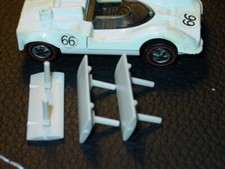
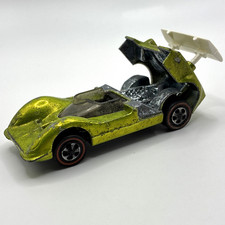
Must include the plastic removable rear wing to be considered complete. |
| Missing rear wing |
Incomplete and should not be valued the same as a complete example. |
| Original decal sheet |
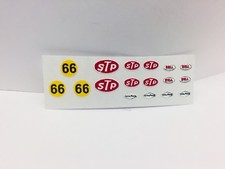
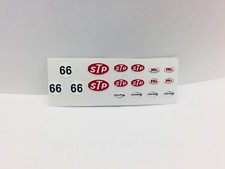
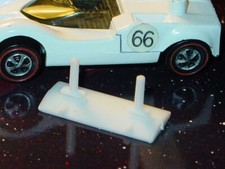
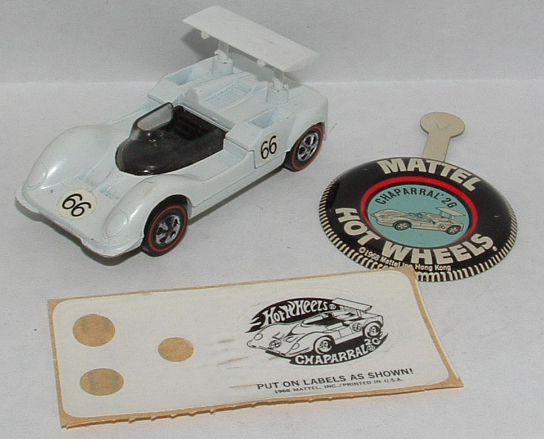
The car was issued with a decal sheet including number “66”; unused original decal material can add collector interest. |
| Condition sensitivity |
Paint wear, broken or reproduction wings, wheel damage, axle issues, and decal condition all affect value. |
| Pricing confidence |
Limited unless supported by recent, verified sold prices for original, complete examples. |
Collector Summary
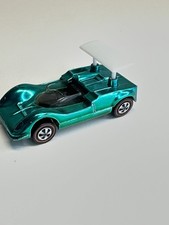
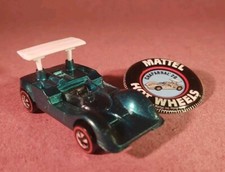
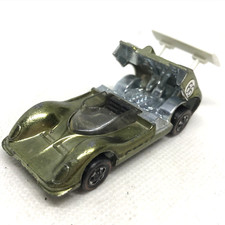
The 1969 Hot Wheels Redline Chaparral 2G is part of the Grand Prix Series and was designed by Ira Gilford. Its listed production run is 1969 through 1971. The model represents the Chaparral 2G race car and is one of the Redline-era open race castings where completeness matters heavily because of its separate rear wing.
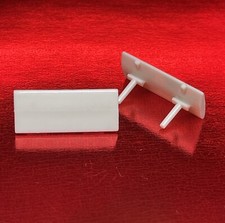
The key identifying feature for collectors is the plastic, removable rear wing. A Chaparral 2G without this wing should be treated as incomplete. The model also came with a decal sheet that included the number “66.” Loose cars are often found with no decals, partial decals, worn decals, or replacement decals, so decal originality should be evaluated carefully.
Known Variations and Details
- Series: Grand Prix Series.
- Designer: Ira Gilford.
- Production run: 1969-1971.
- Rear wing: Plastic, removable, and required for the car to be considered complete.
- Decals: Issued with a decal sheet including number “66.”
- Wheel setup: Listed with 2 medium and 2 small Redline wheels.
When evaluating a loose example, confirm that the wheel sizes match the expected configuration and that the axles have not been swapped, bent, or altered. Wheel and axle originality are important on Redline-era cars, especially for buyers comparing prices across multiple listings.
Color and Desirability Notes
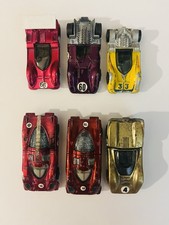
Collector desirability is affected by color, finish quality, completeness, and condition. As with other Redline-era cars, bright original paint with strong shine, clean casting lines, and minimal edge wear is preferred. Toned, faded, oxidized, or heavily handled finishes generally sell for less than clean original examples.
Because Chaparral 2G pricing can vary by color and condition, color should be compared against verified original examples. Repaints, color-shifted photos, lighting differences, and restored cars can make color identification difficult. Do not use a repainted or restored example as a normal price reference for an original car.
Condition Factors That Affect Value
- Rear wing present: The most important completeness factor. Missing-wing cars should be discounted and described as incomplete.
- Wing condition: Check for cracks, stress marks, broken mounting points, warping, incorrect fit, or reproduction replacement.
- Paint condition: Edge wear, chips, scratches, toning, dullness, and corrosion reduce desirability.
- Decals: Original applied decals, unused original decal sheets, partial decals, reproduction decals, and missing decals should be distinguished clearly.
- Wheels: Redline wheels should be checked for chrome loss, wheel wobble, flat spots, axle bends, and mismatched sizes.
- Base: Look for oxidation, scratches, tool marks, and signs of disassembly or restoration.
- Glass and interior: Cracks, clouding, warping, and heavy dirt affect presentation.
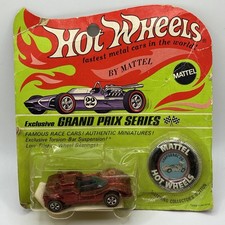
- Packaging: Carded or packaged examples should be evaluated separately from loose cars.
Restorer Notes
The Chaparral 2G is a common restoration candidate because missing or damaged wings are frequently encountered. A restored car can be attractive for display, but it should not be priced or represented as an original survivor. Reproduction wings and reproduction decals should be disclosed clearly.
Restorers should document any repainting, polishing, wheel replacement, axle work, decal replacement, or reproduction accessory use. For collector-grade resale, originality is usually more important than cosmetic improvement. A clean original car with wear is often more desirable to advanced collectors than a restored example with new paint and reproduction parts.
Buyer Cautions
- Do not treat an active asking price as market value. Asking prices may be speculative or unrealistic.
- Confirm that the rear wing is present and fits correctly.
- Ask whether the wing is original or reproduction.
- Ask whether decals are original, replacement, or newly applied.
- Avoid comparing missing-wing cars to complete cars.
- Avoid using repaints, customs, restored examples, or damaged cars as normal value references.
- Check for mismatched wheels, replaced axles, or incorrect wheel sizes.
- Be cautious with lots where the Chaparral 2G cannot be inspected clearly.
- Use sold prices only when the car is clearly identified, original, complete, and comparable in condition.
Seller Notes
Sellers should state clearly whether the Chaparral 2G includes its rear wing and whether the wing is believed to be original. Because the wing is essential to completeness, photograph it from multiple angles and show how it attaches to the car.
Useful listing photos include the top, both sides, front, rear, underside, wheels, axles, base, wing close-ups, and any decals. If an original decal sheet is included, photograph it separately. If decals, wing, wheels, or paint are reproduction or restored, disclose that information directly.
For accurate pricing, compare the car only to actual sold listings for similar original examples. Separate loose cars from carded examples, complete cars from incomplete cars, and original cars from restored or customized cars.
Pricing Analysis
No specific verified sold-price dataset was supplied for this page, so exact value confidence is limited. The most reliable pricing method is to review recent completed sales of original, complete Chaparral 2G examples with the rear wing present, then adjust for condition, color, decal status, and packaging.
Active asking prices should be kept separate from actual sold prices. A high asking price only shows what a seller hopes to receive; it does not prove market value. Actual sold prices are more useful, but only if the sold item is comparable and properly identified.
Strong price differences can occur for this model because of completeness and originality. A clean original car with its original wing will usually be more desirable than a similar car with a reproduction wing. A missing-wing example, a repaint, a custom, or a car in a mixed lot should not be used as a normal price comparison.
Outliers should be reviewed separately. Carded examples, unusually clean loose cars, rare or especially desirable color examples, cars with original decal sheets, and exceptional provenance may sell differently from ordinary loose examples. On the low end, damaged, incomplete, repainted, or misidentified cars can produce prices that do not represent the value of a proper original example.
Listings to Exclude or Treat Carefully
- Cars missing the removable rear wing.
- Cars with reproduction wings unless clearly priced as such.
- Repaints, restorations, customs, and fantasy color examples.
- Listings with reproduction decals presented as original.
- Damaged examples with cracked glass, broken parts, severe wheel damage, or altered axles.
- Mixed lots where the Chaparral 2G condition cannot be verified.
- Wrong-casting or misidentified listings.
- Listings using only blurry, dark, or incomplete photos.
- Active asking prices used as if they were confirmed sales.
New Collector Advice
If you are buying your first Chaparral 2G, start by checking for the rear wing. Without the wing, the car is incomplete. Next, inspect the wheels, axles, paint, decals, and base. A car with honest wear but original parts may be a better collector piece than a shiny restored car with reproduction accessories.
Do not rush to pay based on one high listing. Compare several actual sold examples and make sure they match the car you are considering. Condition, originality, and completeness matter more than a seller’s description.
Advanced Collector Notes
Advanced collectors should pay close attention to wing originality, decal status, wheel correctness, and subtle condition issues such as toning, base oxidation, axle alteration, and paint touch-ups. The Chaparral 2G is a casting where a small accessory can create a large difference in desirability.
When documenting a collection, note the color, wheel configuration, wing status, decal status, base condition, and any restoration concerns. If the car includes an original decal sheet or original packaging, keep that material with the car and document it separately.
Short Page Blurb
The 1969 Hot Wheels Redline Chaparral 2G is a Grand Prix Series casting designed by Ira Gilford and produced from 1969 to 1971. Its removable plastic rear wing is essential for completeness, and the original issue included a decal sheet with number “66.” Values depend heavily on originality, condition, color, decals, and whether the wing is present and original.
Disclaimer
Values for vintage Hot Wheels Redlines can change over time and vary by venue, condition, originality, and buyer demand. This guide does not guarantee exact values. Use actual sold prices for comparable original examples, and treat active asking prices, restored cars, customs, reproduction parts, damaged cars, incomplete cars, and mixed lots separately.
 Total results 11