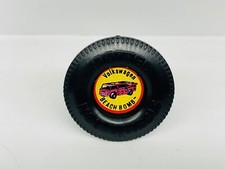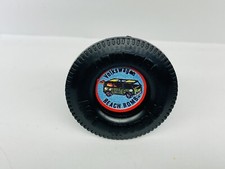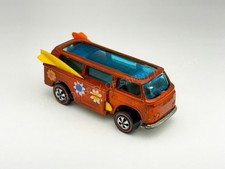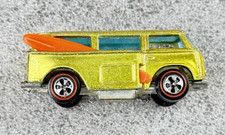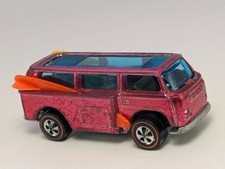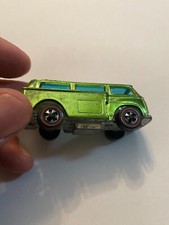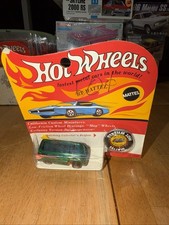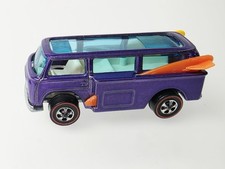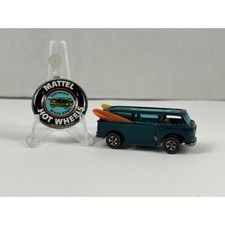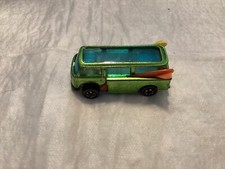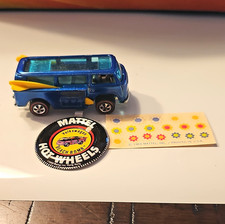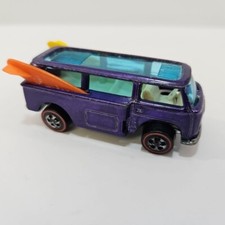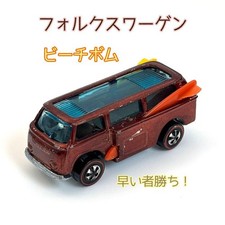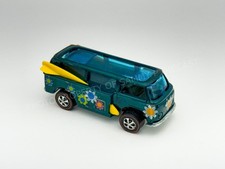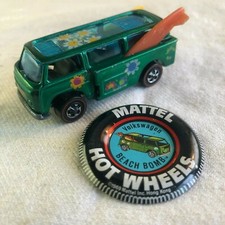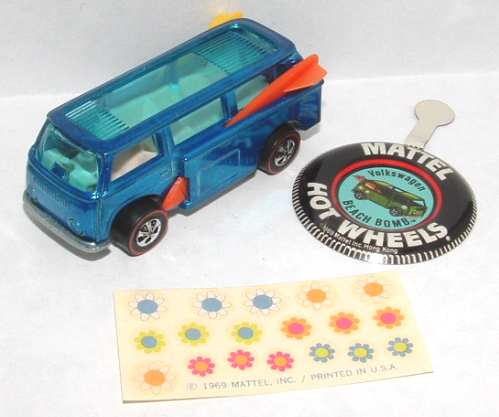
Casting #: 6274
Beach Bomb
Designer: Howard Rees
Production Run: 1969-1971
Note: Produced only in Hong Kong. One of the ultimate Hot Wheels castings, the Beach Bomb is one of the most highly-sought models out there. Even poor examples fetch top dollar prices. As most know, the side-loading Bomb is the standard, but some prototype rear-loaders slipped out into the world and command amazing prices.
Picture and description thanx to NCHWA.comOpenAI/ChatGPT Collector Guide
1969 Hot Wheels Redline Beach Bomb Collector Guide
Quick Value Snapshot
| Category |
Collector Value Outlook |
Confidence |
| Standard side-loading Beach Bomb |
One of the most desirable regular-production Redline-era castings. Even worn examples can bring strong money compared with many common Redlines. |
High |
| High-grade original side-loader with original surfboards |
Very strong collector demand. Condition, color, originality, and surfboard authenticity heavily affect value. |
High |
| Rear-loading Beach Bomb prototype |
Extremely rare prototype category. Values are not comparable to regular side-loaders and must be evaluated individually. |
Limited due to very small sample size |
| Restored, repainted, custom, or reproduction-part examples |
Collectible, but should not be priced as original cars. Value depends on workmanship, disclosure, and parts used. |
Moderate |
Collector Summary
The 1969 Hot Wheels Redline Beach Bomb is one of the key models from the early Redline era. It was designed by Howard Rees and produced from 1969 to 1971. According to the supplied database notes, the casting was produced only in Hong Kong.
The standard production version is the side-loading Beach Bomb, with surfboards mounted along the sides of the vehicle. It is highly sought after by Redline collectors, Volkswagen collectors, and advanced Hot Wheels specialists. The model is notable not only for its design, but also because of the famous rear-loading Beach Bomb prototype, a much rarer version with surfboards loaded from the rear. A small number of rear-loaders are known in collector circles and they are treated as major prototype pieces rather than normal production cars.
Known Variations and Details
| Feature |
Known Detail |
| Model |
Beach Bomb |
| Year |
1969 |
| Designer |
Howard Rees |
| Production run |
1969-1971 |
| Country of production |
Hong Kong only |
| Standard production type |
Side-loading surfboard version |
| Prototype type |
Rear-loading surfboard version |
| Wheel information |
2 medium Redline wheels and 2 small Redline wheels |
The standard Beach Bomb should be evaluated as a Hong Kong Redline casting with its correct wheel setup and correct side-mounted surfboards. Missing surfboards, incorrect replacement surfboards, damaged posts, wheel swaps, or altered bases can significantly affect collector value.
Color and Desirability Notes
Color matters strongly on the Beach Bomb, but originality matters more. Collectors generally place the highest premiums on examples with original paint, strong shine, minimal toning, and clean factory appearance. Certain colors and shades are more difficult to locate than others, and shade variation can affect desirability among advanced collectors.
For this casting, avoid judging value by color alone. A rare or desirable color with heavy wear, reproduction surfboards, or restoration work may be worth less than a cleaner original example in a more available color. Conversely, a very clean original Beach Bomb with correct surfboards can be highly desirable even if the color is not considered the rarest.
The rear-loading Beach Bomb prototype is a separate collecting category. Its value is driven by authenticity, provenance, condition, and expert verification rather than normal color-ranking rules used for production Redlines.
Condition Factors That Affect Value
- Original paint: Factory Spectraflame paint with minimal wear is preferred. Repaints should be disclosed and valued separately.
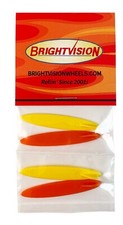
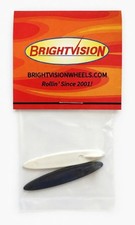
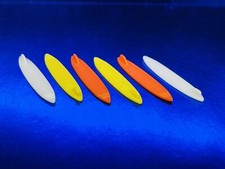
- Surfboards: Original surfboards are important. Missing, reproduction, incorrect-color, or damaged boards reduce value.
- Base condition: Check for corrosion, heavy toning, axle damage, pry marks, or signs that the car has been opened.
- Wheels: The correct setup is 2 medium and 2 small Redline wheels. Wheel swaps, bent axles, and replaced wheels affect value.
- Glass: Cracks, cloudiness, scuffs, or replacement glass should be noted.
- Interior: Original interior condition and fit matter. Warping, discoloration, or swapped interiors should be disclosed.
- Body damage: Bent roof pillars, cracked casting areas, chipped side surfboard mounts, or heavy edge wear lower value.
- Completeness: A complete original car is much more desirable than a project car missing key parts.
- Packaging: Original blister packaging, if present, must be evaluated separately for authenticity and condition.
Restorer Notes
The Beach Bomb is a popular restoration subject because worn originals are often valuable but difficult to upgrade without replacing visible parts. Restorers should clearly distinguish between original, restored, custom, and reproduction-part examples.
- Do not represent a restored Beach Bomb as original.
- Replacement surfboards should be disclosed.
- Repainted Spectraflame-style finishes should be described as restored or custom paint.
- Wheel replacement, axle work, base cleaning, and re-riveting should be disclosed to buyers.
- Original parts from damaged donor cars may improve appearance, but the finished car is still not the same as a fully original untouched example.
Because the Beach Bomb has high collector demand, undisclosed restoration can create serious buyer disputes. Clear disclosure protects both the seller and the hobby.
Buyer Cautions
- Separate asking prices from sold prices. High active listings do not prove market value.
- Confirm the casting. Make sure the listing is for a genuine Redline-era Beach Bomb, not a later reissue, custom, tribute, or wrong-casting listing.
- Check the surfboards carefully. Reproduction boards are common and may not be disclosed.
- Look for restoration signs. Fresh rivets, overly perfect paint, mismatched wear, or incorrect wheels can indicate work has been done.
- Be cautious with rear-loader claims. A claimed rear-loading Beach Bomb should be treated as a major authentication case, not a normal purchase.
- Study photos of the base, wheels, roof, posts, and surfboard area. The highest-risk details are often not visible in one glamour photo.
- Do not price damaged lots as clean singles. Mixed lots, partial cars, and project cars should be evaluated individually.
Seller Notes
When selling a Beach Bomb, detailed disclosure helps achieve buyer confidence. Because this casting is heavily watched by collectors, vague listings can either underperform or create post-sale problems.
- State whether the car is original, restored, custom, or unknown.
- Photograph both sides, front, rear, roof, base, wheels, and surfboards.
- Show close-ups of chips, scratches, corrosion, cracked glass, and board mounts.
- State whether the surfboards are original, reproduction, replaced, or unknown.
- Do not use active asking prices as proof of value.
- If the car has a known repair history, include it in the description.
- If claiming a prototype or rear-loader, provide provenance and be prepared for expert review.
Pricing Analysis
The Beach Bomb is a strong-value Redline casting, but exact pricing depends heavily on condition, originality, color, completeness, and whether the example is the standard side-loader or a rear-loading prototype. The supplied data confirms that even poor examples can bring strong prices, but it does not provide specific verified sale amounts. For that reason, confidence in exact pricing is limited without current sold-price data.
Active asking prices should be treated only as seller expectations. They may be high, outdated, speculative, or based on comparisons to better examples. An asking price is not the same as a completed sale.
Actual sold prices are more useful, but only when the sold example is comparable. A clean original side-loading Beach Bomb with correct surfboards should not be compared directly to a restored car, a damaged project, a reproduction-part example, a mixed lot, or a claimed prototype.
Rear-loading Beach Bomb prototypes are strong outliers. They should be analyzed separately from standard side-loaders because their rarity, documentation, and collector significance place them outside normal production-model pricing.
Listings to Exclude or Treat Carefully
- Active listings with no completed sale.
- Repainted or restored cars listed without clear disclosure.
- Cars with reproduction surfboards presented as original.
- Customs, fantasy colors, tribute builds, or modified castings.
- Mixed lots where the Beach Bomb condition cannot be evaluated separately.
- Damaged examples missing surfboards, wheels, interiors, glass, or base parts.
- Wrong-casting listings using the Beach Bomb name for unrelated Volkswagen models.
- Later reissues or non-Redline versions being compared to 1969 Redline examples.
- Claimed rear-loading prototypes without strong authentication or provenance.
- Sales where packaging, accessories, or multiple cars distort the single-car value.
New Collector Advice
If you are new to Redlines, the Beach Bomb is a casting to study before buying. It is desirable, often expensive, and frequently restored or completed with replacement parts. Start by learning the standard side-loading version, the correct Hong Kong base, the wheel setup, and the role of the surfboards.
Do not rush into a high-priced example based only on a seller’s statement. Compare multiple original examples, study completed sales when available, and ask experienced collectors for opinions if the car appears unusually clean, unusually rare, or unusually expensive.
Advanced Collector Notes
Advanced collectors should focus on originality, shade accuracy, wheel correctness, base condition, and surfboard authenticity. Small differences in condition and completeness can create large value differences on this casting.
The rear-loading Beach Bomb belongs in a separate research category. Any example claimed to be a rear-loader should be examined for casting authenticity, construction details, provenance, and consistency with known prototype characteristics. Because the known population is extremely small, ordinary price guides and standard production comparisons are not reliable for that version.
Short Page Blurb
The 1969 Hot Wheels Redline Beach Bomb, designed by Howard Rees and produced only in Hong Kong, is one of the most important early Redline castings. The standard side-loading version is highly collectible, while the rare rear-loading prototype is a separate high-end authentication category. Condition, originality, correct surfboards, and wheel setup are critical to value.
Disclaimer
This guide is for collector reference only. Values can change over time and exact prices are not guaranteed. Active asking prices should not be treated as market value. Restored cars, customs, reproduction-part examples, damaged cars, lots, wrong-casting listings, and prototype claims must be evaluated separately from normal original production examples.
Gemini/Google AI Collector Guide
1969 Hot Wheels Redline Beach Bomb Collector Guide
Quick Value Snapshot
Due to the iconic status of the Beach Bomb, market values vary significantly based on configuration and condition. The following ranges represent common market observations:
- Standard Side-Loader (Well-played/Beater): Values typically start in the mid-hundreds, even with heavy wear.
- Standard Side-Loader (Average/Good): Solid examples with original boards generally command mid-to-high three-figure prices.
- Standard Side-Loader (Near-Mint/Mint): High-quality examples in desirable colors with original boards frequently reach four-figure prices.
- Rear-Loader Prototype: Extremely rare; these are among the most expensive toy cars in existence, with values reaching the tens or hundreds of thousands depending on the specific history and color.
Collector Summary
Designed by Howard Rees and released in 1969, the Beach Bomb is widely considered the "holy grail" of the Hot Wheels hobby. The model features a Volkswagen bus base with a roof-mounted rack and side-loading slots for two plastic surfboards. While the side-loading version was the standard production model, a narrow-chassis "Rear-Loader" prototype exists. The Beach Bomb was produced exclusively in the Hong Kong factory and features the signature blue-tinted windows and plastic "Basic" or "Deep Dish" wheels common to the era.
Known Variations and Details
- Side-Loader (Production): The standard release featuring side-mounted surfboard pockets. These were widened during design to allow the car to function on Hot Wheels track sets.
- Rear-Loader (Prototype): A narrow-body version where surfboards are inserted through the rear window. Only a small number of these prototypes escaped the factory, primarily into the hands of employees or through early testing.
- Wheel Variations: Standard production uses 2 Medium wheels and 2 Small wheels. Baseplates are typically unpainted zinc.
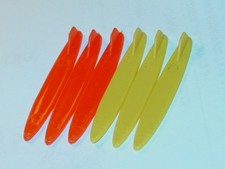
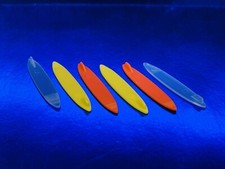
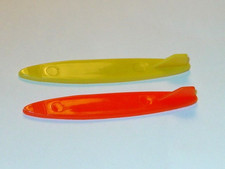
- Surfboards: Original boards were produced in various colors (commonly yellow, orange, red, or aqua). The presence of original boards is a critical factor in valuation.
Color and Desirability Notes
The Beach Bomb was produced in a wide variety of Spectraflame colors. Common colors include Green, Blue, and Aqua. Mid-tier colors include Red, Copper, and Orange. Rare colors include Magenta, Yellow, and Pink. While Pink is legendary for its rarity in the Rear-Loader prototype, it remains a highly sought-after color for the standard Side-Loader as well. Collectors also look for "Toning" (darkening of the paint), where even-colored, bright examples command a premium over heavily toned pieces.
Condition Factors That Affect Value
- Surfboards: The presence of two original, period-correct surfboards is essential. Missing boards or reproduction boards significantly reduce the value.
- Windshield/Pillars: The thin A-pillars are prone to bending or snapping. The blue-tinted plastic windshield is also susceptible to cracking or "fogging."
- Paint Integrity: Spectraflame paint is prone to "micro-planing" or "checking." Collectors prefer smooth, glossy finishes.
- Wheel Chrome: The silver chrome on the Redline wheels often wears off over time. Bright, intact chrome on the hubs increases value.
Restorer Notes
The Beach Bomb is a popular candidate for restoration, but collectors must be careful. Many "found" Beach Bombs are missing their boards; high-quality reproduction boards are available but must be disclosed during any sale. Because the Beach Bomb was only produced in Hong Kong, restorers should ensure they use the correct blue-tinted glass and Hong Kong-style wheel sets if performing a part-swap. Professional-grade paint matching for Spectraflame is required to maintain the visual integrity of the casting.
Buyer Cautions
- Fake Rear-Loaders: Due to the extreme value of the Rear-Loader, "custom" versions created by cutting and welding standard Side-Loaders exist. Verify provenance and casting seams before purchasing high-end prototypes.
- Reproduction Boards: It can be difficult to distinguish between original 1969 surfboards and modern reproductions. Original boards typically have specific molding marks and a certain plastic translucency.
- Casting Fatigue: Some Hong Kong castings suffer from "zinc pest," where the metal becomes brittle and may crumble. Check the base for fine cracks.
Seller Notes
When selling a Beach Bomb, clear photography of the surfboard slots and the roof rack is vital. Sellers should explicitly state if the surfboards are original to the car or replacements. Highlighting the condition of the A-pillars and the clarity of the windshield glass will help justify higher asking prices. If the car has any "toning" (natural darkening of the metal under the paint), it should be noted, as some collectors prefer the "patina" while others seek "brilliant" examples.
Pricing Analysis
Asking Prices: It is common to see Side-Loader Beach Bombs listed on auction sites with "Buy It Now" prices ranging from $800 to $2,500 depending on color. However, asking prices are often aspirational and do not reflect the actual market clearing price.
Sold Prices: Actual sold data shows that "beater" examples (missing paint, no boards, bent axles) consistently sell in the $150–$300 range. Solid, mid-grade examples with boards generally clear between $500 and $900. High-grade, rare-color examples regularly exceed $1,500.
Confidence: High. The market for the Beach Bomb is very active with high volume, providing a clear picture of current demand.
Listings to Exclude or Treat Carefully
- Restored/Code 3: Do not use prices from restored or "custom" painted Beach Bombs to value original survivors.
- Missing Boards: Listings without surfboards are technically "incomplete" and should not be used as the benchmark for a complete model.
- Wheel Swaps: Examples with replaced wheels or reproduction Redline stickers should be valued lower than 100% original survivors.
New Collector Advice
For those just starting, the Beach Bomb is a significant financial commitment. It is often better to buy a lower-condition "placeholder" example and upgrade later. Be wary of "deals" that seem too good to be true, especially regarding the Rear-Loader version or rare colors like Pink. Always prioritize the structural integrity of the roof rack and A-pillars, as these cannot be easily repaired without destroying the original paint.
Advanced Collector Notes
Advanced collectors focus on "attributes of excellence." This includes searching for examples with "Deep Dish" wheels (if applicable to the specific run), perfectly clear glass with no interior dust, and surfboards that match the known factory-shipped color pairings. At this level, the distinction between a $1,000 car and a $3,000 car often comes down to the absence of "micro-checking" in the Spectraflame paint and the brilliance of the base metal.
Short Page Blurb
The 1969 Hot Wheels Beach Bomb is the definitive Redline-era collectible. Produced only in Hong Kong and designed by Howard Rees, this VW Bus casting is a cornerstone of any serious collection. Whether you are hunting for a standard Side-Loader or the legendary Rear-Loader prototype, the Beach Bomb remains a high-demand model that defines the "Golden Age" of Hot Wheels.
Disclaimer
The information provided on this page is for educational and entertainment purposes only. Market values for vintage collectibles fluctuate based on demand, auction timing, and platform. RedlinePriceGuide.com does not guarantee specific sale prices or investment outcomes. Always consult with a professional appraiser for high-value transactions.
Online Redline Guide / Color Reference
Wheels: 2 Med, 2 Sm
HK Colors
| Color | Comments |
|---|
| Aqua | common |
| Green | common |
| Blue | common |
| Red | uncommon |
| Olive | uncommon |
| Purple | uncommon |
| Copper | uncommon |
| Light green | uncommon |
| Brown | hard to find |
| Orange | hard to find |
| Rose | very hard to find |
| Yellow | rare |
NCHWA.com Ratings
MINT Loose pricing below probably. Check ebay for blister pricing.
Note that these values are very old. Typical selling prices can be significantly higher now. Check the AI summaries for more info or ebay listings here.
Please see NCHWA.com Grading Page to reduce value due to condition.
| Color | US
Rating | US
Value | HK
Rating | HK
Value |
|---|
| Aqua | . | . | 6 | $138 |
| Green | . | . | 7 | $163 |
| Blue | . | . | 8 | $188 |
| Red | . | . | 9 | $213 |
| Olive | . | . | 12 | $288 |
| Purple | . | . | 12 | $288 |
| Copper | . | . | 13 | $326 |
| Light Green | . | . | 15 | $426 |
| Brown | . | . | 16 | $476 |
| Orange | . | . | 17 | $526 |
| Rose | . | . | 18 | $576 |
| Lime | . | . | 19 | $626 |
| Yellow | . | . | 19 | $626 |
| Red | . | . | 40+ | $5,200 |
| Blue | . | . | 40+ | $5,200 |
| Green | . | . | 40+ | $5,200 |
| Antifreeze | . | . | 40+ | $5,200 |
| Purple | . | . | 40+ | $5,200 |
| Gold | . | . | 40+ | $5,200 |
| Rose (rear loader | . | . | 40+ | $5,200 |
| Hot Pink | . | . | 40+ | $5,200 |
| Light Blue | . | . | 40+ | $5,200 |
| | . | | . |
Looking for reproduction redline parts?

Total results 22
Average price for this page is $24